


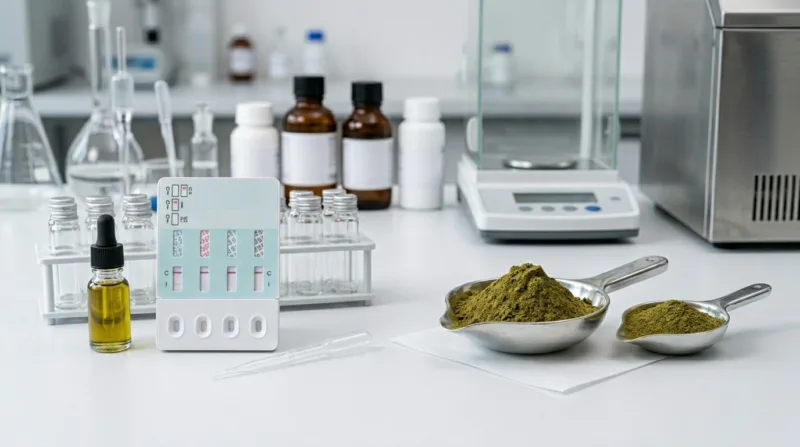
If you compete in sanctioned sports, serve in the military, or hold a job that subjects you to random urine screening, one question follows you into the supplement aisle: can hemp protein powder make me fail a drug test? The short answer: high-quality, properly processed hemp protein contains THC at levels too low to trigger a confirmed positive on a standard two-step workplace drug screening protocol. Understanding why requires a look at how drug tests actually work, what the legal THC thresholds are in different countries, and what distinguishes a verified product from one that carries uncertainty.
This article walks through the science without speculation, the regulations without exaggeration, and the practical steps anyone in a safety-sensitive position can take to use hemp protein with confidence. We cover the two-step testing methodology used by certified laboratories, the specific numerical cutoffs applied in the United States and European Union, why hemp seeds are an inherently low-THC starting material, and exactly how HEMPLAND tests its products to deliver a result you can document. (If you are wondering whether hemp seed oil raises similar questions, see our breakdown of hemp seed oil and drug screening facts.)
How Drug Testing Laboratories Screen for THC
Workplace drug tests do not search for THC as a free molecule in your bloodstream. They search for metabolites — chemical byproducts your body produces after processing THC — and the primary target in urine screening is 11-nor-9-carboxy-delta-9-tetrahydrocannabinol, known as THC-COOH.
Every certified drug testing program uses a two-step protocol. Step one is an immunoassay screen, most commonly the enzyme-linked immunosorbent assay or ELISA. A urine sample is exposed to antibodies designed to capture THC-COOH. The cutoff for a presumptive positive in U.S. federal workplace programs, established by the Substance Abuse and Mental Health Services Administration (SAMHSA), is 50 nanograms per milliliter (ng/mL).
Immunoassays are presumptive tests. The antibodies can cross-react with structurally similar compounds in certain prescription medications, and in theory with compounds present in under-purified hemp products. This is why every positive immunoassay must be confirmed by a more specific method before being reported as verified.
That second method is gas chromatography-mass spectrometry (GC-MS). GC-MS separates compounds by chemical properties and identifies each by its mass spectrum, eliminating virtually all cross-reactivity. The GC-MS confirmation cutoff for THC-COOH is 15 ng/mL — lower than the screening cutoff because greater specificity allows precise quantification. The practical takeaway for hemp protein users: even if a contaminated product hypothetically pushed someone near the 50 ng/mL screening threshold, GC-MS would need to independently confirm THC-COOH above 15 ng/mL. A product verified to contain near-zero THC cannot produce a confirmed positive.
U.S. Regulatory THC Thresholds
The Agriculture Improvement Act of 2018 (the Farm Bill) defines industrial hemp as Cannabis sativa L. containing no more than 0.3 percent delta-9-THC on a dry weight basis. Material exceeding 0.3 percent is marijuana under federal law.
This percentage threshold applies to raw plant material, not processed food ingredients. During hemp protein manufacturing, seeds are cleaned, dehulled, cold-pressed to remove oil, and milled. THC is concentrated in the resin glands on cannabis flowers and leaves — not in seeds. Raw hemp seeds contain THC measured in parts per million. After cleaning and dehulling remove surface resin from harvest contact, the remaining seed material has only negligible THC traces.
The U.S. Food and Drug Administration considers hemp seed, hemp seed protein, and hemp seed oil generally recognized as safe (GRAS) when produced to established practices, based on the finding that these ingredients contain only trace THC that raises no safety concern. The FDA has not set a specific THC action level for hemp seed-derived foods.
For drug testing purposes, the actual THC concentration in the finished powder is what matters. A hemp protein manufactured from clean, properly sourced seeds and tested by a quality-conscious company will contain THC at single-digit parts per million or lower — orders of magnitude below any amount that could affect a drug test.
European Union and Chinese THC Standards
The European Union sets the permitted THC level in hemp seeds and seed-derived products at 2.0 milligrams per kilogram (mg/kg), or 2.0 parts per million, measured as the sum of delta-9-THC and its acidic precursor THCA adjusted for decarboxylation.
The European Food Safety Authority (EFSA) has established an acute reference dose for THC of 1 microgram per kilogram of body weight. For a 70-kilogram adult, that equals 70 micrograms. Consuming 30 grams of hemp protein at the EU maximum of 2.0 mg/kg would deliver 60 micrograms of THC — below the EFSA acute reference dose. Most quality hemp proteins contain far less than the regulatory ceiling.
China, a historically major hemp producer, maintains provincial cultivation licensing and national food standards. Chinese THC regulations for hemp-derived foods are less publicly transparent than U.S. or EU frameworks, and enforcement varies. For export-oriented products targeting international markets, manufacturers adhere to the destination country’s standards, making the EU 2.0 mg/kg threshold the practical benchmark for globally traded hemp protein.
These varying frameworks share a common conclusion: properly processed hemp seed products contain THC at levels deemed safe from both a health and a regulatory perspective. No major regulatory body has identified THC in hemp protein as a public health concern or a meaningful drug testing risk when products are manufactured to applicable standards.
Why Hemp Seeds Contain So Little THC
Cannabis produces cannabinoids — including THC — primarily in trichomes, tiny resin glands on the flowers and, to a lesser degree, the leaves of female plants. Hemp seeds develop inside the flower but are not cannabinoid-producing structures. The seed hull can acquire trace surface contamination from contact with resin-bearing plant material during harvest. This is why cleaning, dehulling, and batch testing matter. Once seeds are cleaned and hulls removed, the remaining seed material contains THC at levels challenging the detection limits of standard analytical instruments.
A 2020 study in the Journal of Agricultural and Food Chemistry analyzed cannabinoid content across hemp food products and found properly processed hemp seed protein had THC concentrations consistently at or below the limit of quantification — effectively absent. An analysis in Food Additives and Contaminants concluded that THC transfer from plant material into the food chain through hemp seed products is minimal under normal manufacturing.
The protein fraction is safer still than hemp oil. Cannabinoids are fat-soluble and partition into the oil during pressing. The protein cake remaining after oil removal undergoes further cannabinoid depletion. A quality manufacturer confirms non-detectable levels through finished product testing. (For a detailed comparison of how hemp protein stacks up against other plant proteins like sunflower, pumpkin, and soy, check our hemp protein vs sunflower vs pumpkin vs soy comparison.)
HEMPLAND’s Multi-Stage THC Verification
HEMPLAND approaches THC assurance through a quality control sequence that begins at sourcing and continues through to the packaged product. No single test at the end of the line substitutes for controls at every stage.
Incoming raw hemp seeds are tested for cannabinoid content before entering the manufacturing stream. The panel covers delta-9-THC, THCA, cannabidiol (CBD), and cannabidiolic acid (CBDA). Any lot exceeding internal acceptance criteria — which are tighter than any published regulatory threshold — is rejected before processing starts.
Accepted seeds proceed through mechanical processing: cleaning to remove field debris, dehulling to strip the outer shell where surface contamination would collect, cold pressing to extract the oil fraction, and fine milling of the remaining protein cake. No chemical solvents are used. Because the starting seeds already contain negligible THC and the processing mechanically removes the oil fraction where cannabinoids would concentrate, THC is not introduced or concentrated at any step.
The finished protein powder undergoes independent third-party analysis using liquid chromatography with tandem mass spectrometry (LC-MS/MS). This method achieves sensitivity at the parts-per-billion level — far beyond what is needed to detect THC at concentrations relevant to drug testing. HEMPLAND’s finished product specification is non-detect at the method’s reporting limit. Batch-specific certificates of analysis are available for customers who need documentation: employers verifying supplier claims, nutritionists managing athlete programs, or individual consumers who want facts rather than assurances. You can learn more about HEMPLAND Organic Hemp Seed Protein on our product page.
The Real-World Answer: Can Hemp Protein Trigger a Positive Drug Test
Practical risk, not theoretical edge cases, determines real safety. To reach the SAMHSA 50 ng/mL immunoassay cutoff, a person must consume enough THC that their body produces and excretes a detectable concentration of THC-COOH. Research published in the Journal of Analytical Toxicology examined subjects consuming hemp oil with THC levels well above the EU regulatory limit — concentrations that would not exist in a verified product. Most subjects never approached 50 ng/mL. In the few borderline cases, GC-MS confirmation resolved results as negative.
A separate Journal of Analytical Toxicology study gave subjects hemp oil with known THC doses over ten days. Even at daily doses far exceeding what a serving of properly processed hemp protein could deliver, urine concentrations stayed below 50 ng/mL for most participants. Results that exceeded the cutoff were corrected by GC-MS.
Hemp protein adds an additional safety margin beyond hemp oil. Because cannabinoids are fat-soluble and partition into the oil during pressing, the protein fraction is further depleted of residual THC. Quality manufacturers confirm this through testing. Published research and real-world experience both support the conclusion: verified THC-free hemp protein does not cause positive drug test confirmations.
Safety for Athletes, Military, and Regulated Professionals
For individuals facing career-altering consequences from a positive drug test — athletes facing competition bans, service members facing administrative action, transportation workers under federal regulation — probabilistic reassurance is insufficient. These users need documented verification.
The World Anti-Doping Agency (WADA) lists THC as a prohibited substance in-competition under category S8 (cannabinoids). The WADA urinary threshold for THC-COOH is 150 ng/mL — three times the SAMHSA workplace screening cutoff and ten times the confirmation cutoff. This threshold is calibrated to distinguish intentional cannabis use from environmental exposure. Dietary THC traces from hemp foods are irrelevant at this concentration.
Professional and collegiate athletic programs maintain dietary supplement review procedures where team staff evaluate each product. HEMPLAND’s batch certificates of analysis provide the documentation these programs require. An athlete presenting a protein container with a verifiable certificate showing non-detectable THC has a materially stronger position than one using undocumented product.
Uniformed service members fall under branch-specific drug testing programs that mirror SAMHSA guidelines — 50 ng/mL screening and 15 ng/mL confirmation cutoffs. While no U.S. military branch has issued blanket guidance specifically naming hemp protein, service members bear responsibility for substances they consume. This is discharged by selecting products from manufacturers providing third-party verification.
Department of Transportation-regulated employees undergo mandatory testing under 49 CFR Part 40, which follows the SAMHSA two-step protocol. DOT guidance acknowledges the hemp-marijuana distinction while noting that the origin of a positive test provides no defense. For these professionals, manufacturer documentation of non-detectable THC is the practical safeguard.
Reading a Certificate of Analysis
A certificate of analysis (COA) converts a THC-free claim into a verifiable fact. Key elements to evaluate: analytical method, reporting limits, and results for delta-9-THC and THCA.
The limit of detection (LOD) is the lowest concentration where the method can confirm a substance is present. The limit of quantification (LOQ) is the lowest concentration where the method can measure the amount accurately. A COA reporting THC as “not detected” at a LOQ of 0.01 parts per million provides more information than one reporting the same finding at 2 parts per million. Lower reporting limits increase confidence.
A complete COA for hemp protein should report results for both delta-9-THC and THCA. THCA converts to active THC when heated. Some laboratories report total THC as delta-9-THC plus 87.7 percent of THCA (accounting for decarboxylation weight change). Others report each analyte separately. Both formats work when individual values are disclosed.
The COA should name the testing laboratory and include accreditation information. ISO/IEC 17025 is the international standard for testing laboratory competence. A certificate from an ISO 17025-accredited facility carries independent audit verification. The batch or lot number on the COA must match the number on your product container — otherwise the COA is a marketing document rather than a quality record. HEMPLAND provides batch-specific COAs so customers can trace their exact container to verified test results.
Practical Guidelines for Drug-Safe Hemp Protein Use
Product selection is the single most impactful decision. Choose a supplier that publishes THC testing results and makes COAs available. A documented product costs less than retaining legal counsel to dispute a test result.
When you receive a new container, check the batch code against the manufacturer’s published COA. If your batch shows THC as non-detect at a low LOQ, the product in your hands is verified. Store a copy of the COA — documenting product contents is best done before a test, not after.
Store hemp protein in a cool, dry environment with the container sealed between uses. Proper storage does not affect cannabinoid levels, but it preserves quality and prevents spoilage. If household members use cannabis products, store your protein separately to eliminate a theoretical variable.
Common Questions About Hemp Protein and Drug Testing
How much hemp protein would I need to consume to risk a positive test?
With a verified THC-free product, there is no amount that would trigger a confirmed positive. THC levels in a tested product fall below the analytical method’s detection capability.
Does the drug test type matter — urine, blood, hair, or saliva?
Urine testing is the workplace standard, using the 50 ng/mL ELISA cutoff. Blood testing measures active THC with shorter detection windows and is used in post-accident contexts. Hair testing requires sustained systemic exposure over months — far above dietary trace levels. Saliva testing detects active THC with a short window. In every case, verified THC-free hemp protein does not introduce THC at detectable levels.
Is CBD protein the same concern as hemp protein?
No. Hemp protein is made from seeds, not the flowering material used for CBD extraction. These products are manufactured from different starting materials with different cannabinoid profiles.
Can secondhand smoke exposure affect my drug test?
SAMHSA cutoffs were selected to exclude environmental exposure. Research on passive cannabis smoke in unventilated spaces shows trace THC-COOH may appear in urine but reaches the 15 ng/mL confirmation cutoff only in extreme edge cases. Dietary exposure from hemp foods involves far lower THC doses than passive smoke.
Conclusion
The concern about hemp protein and drug testing is grounded in a reasonable question — hemp and marijuana share a plant species — but the evidence does not support it when properly processed, verified products are used. THC concentrates in flowers and leaves, not in seeds. Mechanical processing removes oil where cannabinoids would collect. Finished product testing confirms non-detectable levels.
HEMPLAND’s testing protocol incorporates raw material screening at intake, cannabinoid control throughout processing, and independent third-party analysis of the finished powder. Batch-specific COAs allow every customer to trace their product back to verified data.
Athletes navigating WADA compliance, service members under military drug testing, transportation workers regulated by DOT, and anyone whose career depends on clean drug tests all share the same principle: choose a product backed by data, not just marketing language. Documentation turns a claim into something verifiable.
For product-specific testing documentation, Contact Us. Our team can provide batch certificates of analysis for your region and the product you use.