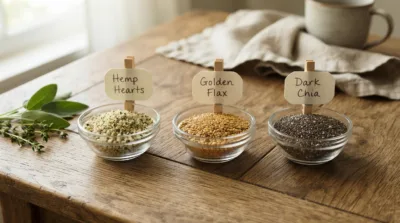
Two seeds dominate the conversation around plant-based superfoods: hemp hearts and chia seeds. Both carry ancient cultivation histories, hemp in Central Asia dating back to roughly 10,000 BCE, chia in Mesoamerica as a staple of Aztec and Mayan diets. Modern nutritional science and consumer demand for functional, minimally processed whole foods have lifted both into the spotlight. But the two seeds are not interchangeable, and the differences between them matter for anyone making purchase decisions based on specific nutritional goals.
The numbers below come from the USDA FoodData Central database, peer-reviewed food composition studies, and published nutritional analyses. They compare hemp hearts and chia seeds across protein quality, fatty acid profiles, fiber, minerals, culinary flexibility, and price.
Nutritional overview: side-by-side per serving
The following table compares standard 30-gram servings (about 3 tablespoons of hemp hearts, 2 tablespoons of chia seeds) based on USDA data:
| Nutrient (per 30g serving) | Hemp Hearts | Chia Seeds |
|---|---|---|
| Calories | 166 kcal | 138 kcal |
| Protein | 9.5 g | 4.7 g |
| Total Fat | 14.6 g | 8.7 g |
| Saturated Fat | 1.4 g | 0.9 g |
| Monounsaturated Fat | 1.6 g | 0.6 g |
| Polyunsaturated Fat | 11.3 g | 6.7 g |
| Omega-3 (ALA) | 2.6 g | 5.1 g |
| Omega-6 (LA) | 8.2 g | 1.4 g |
| Omega-6:Omega-3 Ratio | 3.1:1 | 0.3:1 |
| Carbohydrates | 2.6 g | 12.0 g |
| Dietary Fiber | 1.2 g | 10.0 g |
| Calcium | 21 mg (2% DV) | 179 mg (14% DV) |
| Iron | 2.4 mg (13% DV) | 1.6 mg (9% DV) |
| Magnesium | 210 mg (50% DV) | 95 mg (23% DV) |
| Phosphorus | 495 mg (40% DV) | 244 mg (20% DV) |
| Zinc | 3.0 mg (27% DV) | 1.0 mg (9% DV) |
| Potassium | 360 mg (8% DV) | 115 mg (2% DV) |
| Manganese | 2.3 mg (100% DV) | 0.6 mg (30% DV) |
| Thiamin (B1) | 0.4 mg (33% DV) | 0.1 mg (8% DV) |
| Niacin (B3) | 2.8 mg (18% DV) | 1.3 mg (8% DV) |
| Folate | 33 µg (8% DV) | 15 µg (4% DV) |
The immediate takeaway: hemp hearts lead on protein, minerals, and B vitamins. Chia seeds lead on fiber, calcium, and absolute omega-3 ALA content. The caloric difference reflects the higher fat content of hemp hearts and the higher carbohydrate plus fiber content of chia seeds.
Protein: quality and quantity
Quantity
Hemp hearts deliver roughly double the protein of chia seeds on a per-serving basis, 9.5 grams versus 4.7 grams per 30 grams. On a per-calorie basis, hemp hearts provide 5.7 grams of protein per 100 calories, while chia seeds provide 3.4 grams. For people targeting higher protein intake, athletes, older adults, and those on plant-based diets, hemp hearts are the more protein-efficient choice.
Amino acid completeness
Hemp hearts contain all nine amino acids the body cannot make. Edestin and albumin, the dominant proteins, provide a balanced profile including adequate lysine, often limited in grains. Chia seeds also contain all nine essential amino acids but at lower total levels, with proportionally lower lysine.
The protein digestibility-corrected amino acid score (PDCAAS):
- Hemp protein: about 0.46 to 0.63 (varies by processing)
- Chia protein: limited published data; estimated similar range but lower utilizable protein due to lower absolute content
Neither seed matches soy or animal protein on PDCAAS, but hemp delivers more total utilizable protein per serving.
Satiation and muscle maintenance
Higher protein intake increases satiety through peptide YY and GLP-1 release while suppressing ghrelin. Hemp hearts contribute more to a meal’s total protein load. For athletes, hemp protein supports muscle protein synthesis and recovery, as covered in hemp hearts in sports nutrition.
Omega-3 and omega-6 fatty acids: the ratio question
The omega fatty acid profiles of hemp hearts and chia seeds diverge in a way that defines one of the most meaningful differences between the two.
Chia seeds: omega-3 dominance
Chia seeds deliver 5.1 grams of ALA per 30-gram serving with only 1.4 grams of linoleic acid (omega-6). This yields an omega-6 to omega-3 ratio of roughly 0.3:1, meaning chia seeds provide more than three times as much omega-3 as omega-6. This is unusual among plant foods and makes chia seeds a targeted source of ALA for people whose overall diet is already high in omega-6 from vegetable oils, nuts, and processed foods.
Hemp hearts: balanced ratio
Hemp hearts provide 2.6 grams of ALA and 8.2 grams of LA per serving, yielding a ratio of roughly 3:1, omega-6 to omega-3. This ratio aligns with dietary recommendations from the World Health Organization and the Food and Agriculture Organization, which suggest an omega-6 to omega-3 ratio between 2:1 and 5:1 for general health.
GLA: the differentiator
Hemp hearts contain gamma-linolenic acid (GLA), an omega-6 fatty acid that is metabolized through an anti-inflammatory pathway distinct from the pro-inflammatory pathway of linoleic acid. Chia seeds contain no measurable GLA. For people seeking the specific anti-inflammatory signaling effects associated with GLA, hemp hearts provide a dietary source that chia seeds do not match.
Practical application
If your goal is to increase absolute omega-3 ALA intake, chia seeds deliver more per serving. If your goal is to consume omega-3 and omega-6 in a balanced ratio with the added benefit of GLA, hemp hearts are the better fit. Many nutritionally informed consumers use both, chia for ALA density in smoothies and puddings, hemp for balanced fatty acid intake and protein across a wider range of foods.
Fiber: quantity and type
Chia seeds: fiber powerhouse
With 10 grams of dietary fiber per 30-gram serving (36% of the daily value), chia seeds are one of the most fiber-dense foods available. The fiber in chia is predominantly soluble, forming a gel when mixed with water. This soluble fiber, primarily a mucilage composed of xylose, glucose, and glucuronic acid polymers, delays gastric emptying, moderates post-meal blood sugar, and serves as a fermentable substrate for beneficial gut bacteria.
The gel-forming property of chia fiber creates applications in egg-free baking (as an egg substitute), pudding preparation, and beverage thickening, but it also means chia seeds require liquid contact to achieve their functional texture.
Hemp hearts: modest fiber, maximum flexibility
At 1.2 grams of fiber per serving, hemp hearts do not compete with chia seeds on fiber quantity. However, the fiber that hemp hearts do contain is a mix of soluble and insoluble fractions, and this is the practical differentiator: hemp hearts do not form a gel. They can be added to any food, dry or wet, without altering the food’s texture. This makes hemp hearts a practical everyday fiber source that adds to cumulative intake without requiring recipe adjustments.
Which is better for digestion
For people specifically targeting increased dietary fiber, for cholesterol management, blood sugar control, or digestive regularity, chia seeds are more efficient. For people who want a seed-based food that integrates seamlessly into existing meals without gelling or thickening, hemp hearts are the more practical choice.
Mineral comparison: where each seed excels
Magnesium, zinc, and phosphorus: hemp hearts lead
Hemp hearts outperform chia seeds dramatically on several minerals:
- Magnesium: 210 mg versus 95 mg per serving. Hemp hearts provide 50% of the daily magnesium requirement in a single serving, among the highest magnesium density in any whole food. Magnesium is a cofactor in over 300 enzymatic reactions, including those involved in muscle function, nerve signaling, and blood pressure regulation.
- Zinc: 3.0 mg versus 1.0 mg per serving. Zinc contributes to the normal function of the immune system and to normal DNA synthesis. The zinc density of hemp hearts makes them relevant for plant-based eaters, who often consume lower amounts of bioavailable zinc due to phytate interference in legumes and grains.
- Phosphorus: 495 mg versus 244 mg per serving. Phosphorus combines with calcium to mineralize bone and is central to ATP production. Hemp hearts provide 40% of the daily phosphorus requirement in one serving.
Calcium: chia seeds lead
Chia seeds deliver 179 mg of calcium per serving (14% DV) compared to hemp hearts’ 21 mg (2% DV). For people on dairy-free diets who rely on plant sources for calcium, chia seeds are the clearly preferable choice between the two seeds. However, the bioavailability of calcium from chia seeds is moderated by oxalates, compounds that bind calcium and reduce absorption. The effect is modest but worth noting when comparing calcium from chia seeds to calcium from dairy or fortified products.
Iron, manganese, and b vitamins
Hemp hearts provide more iron (2.4 mg vs 1.6 mg), substantially more manganese (2.3 mg vs 0.6 mg, 100% DV in a single hemp heart serving), and roughly two to three times the B-vitamin content of chia seeds. For people with increased iron requirements, menstruating women and endurance athletes, hemp hearts contribute more meaningfully to daily iron intake.
Culinary uses and recipe flexibility
Hemp hearts: ready-to-eat versatility
Hemp hearts are soft and nutty, requiring no preparation. Their texture is similar to a cross between a pine nut and a sunflower seed kernel. They can be:
- Sprinkled directly onto any dish, oatmeal, yogurt, salads, soups, grain bowls
- Blended into smoothies without affecting texture
- Mixed into baked goods, muffins, breads, cookies, crackers
- Used as a coating for proteins or energy balls
- Eaten by the spoonful as a standalone snack
The absence of any gelling or thickening property means hemp hearts add nutrition without changing the physical properties of the food they are added to. For product developers formulating bars, cereals, or functional snacks, this formulation neutrality is an advantage.
Chia seeds: gelling and binding
Chia seeds absorb up to 12 times their weight in water, enabling applications hemp hearts cannot replicate:
- Chia pudding, the seed’s signature dish
- Vegan egg replacement (1 tablespoon chia plus 2.5 tablespoons water equals 1 egg)
- Thickening smoothies, sauces, and jams
- Hydration support for endurance athletes
The tradeoff: chia must be incorporated deliberately. Dry chia on a salad absorbs moisture from surrounding ingredients, creating an undesirable texture. Soaking fixes this but adds prep time.
Which seed for which kitchen
| Culinary Goal | Better Choice |
|---|---|
| Add protein and minerals without changing food texture | Hemp hearts |
| Make pudding or egg-free baked goods | Chia seeds |
| Sprinkle on yogurt or oatmeal | Hemp hearts (no soaking needed) |
| Thicken a smoothie | Chia seeds |
| Create plant-based energy bars | Hemp hearts (dry binding) |
| Add omega-3 to beverages | Both work; chia for more ALA per spoonful |
| No-prep snack | Hemp hearts |
Taste and texture profiles
Hemp hearts
Mild, nutty, faintly grassy. The flavor is subtle enough that hemp hearts do not dominate a dish but distinct enough to add depth when used as a topping. They pair well with both sweet (fruit, honey, chocolate) and savory (roasted vegetables, grains, herbs) profiles.
Chia seeds
Chia seeds have minimal flavor in the dry state, neutral to slightly nutty. When soaked, the gel texture is the dominant sensory feature, not taste. This neutrality suits flavor masking, but the gel texture is polarizing.
Price comparison and value
Hemp hearts retail at a higher per-pound price than chia seeds. As of 2024 to 2025:
- Organic hemp hearts: approximately $10 to $16 per pound
- Organic chia seeds: approximately $6 to $10 per pound
Three factors explain the gap:
- Yield: hemp yields roughly 400 to 800 pounds of seed per acre; chia yields 500 to 1,200 pounds.
- Processing: hemp hearts require hulling (shell removal); chia seeds are consumed whole.
- Supply chain: chia has established production hubs across Mexico, Bolivia, Paraguay, and Argentina. U.S. hemp production is rebuilding after decades of prohibition and remains supply-constrained.
Value per nutrient
At the higher price point, hemp hearts provide more protein, magnesium, zinc, iron, phosphorus, and B vitamins per dollar. Chia seeds provide more fiber, calcium, and absolute omega-3 ALA per dollar. The value calculation depends on which nutrients you are prioritizing:
- Protein and mineral density per dollar: hemp hearts
- Fiber and calcium per dollar: chia seeds
- Omega-3 ALA per dollar: chia seeds
For consumers who can afford both, using chia seeds for their ALA and fiber content while relying on hemp hearts for protein and minerals provides the broadest nutritional coverage. For a closer look at sourcing and quality, see our buyer’s guide to high-quality organic hemp hearts.
Who should choose hemp hearts
Hemp hearts are the better choice for:
- Protein-first consumers: athletes, older adults, and anyone targeting higher protein intake benefit from 9.5 grams of complete protein per serving.
- Mineral-focused consumers: magnesium (50% DV), zinc (27% DV), phosphorus (40% DV), and manganese (100% DV) per serving make hemp hearts a uniquely dense mineral source.
- Culinary minimalists: zero preparation, no soaking, no gelling, no recipe adaptation.
- GLA seekers: gamma-linolenic acid in hemp hearts is absent from chia seeds and most plant foods.
- Food formulators: neutral texture and dry-binding compatibility streamline product formulation.
To explore the health benefits of hemp hearts in more depth, see are hemp hearts good for you and our top 10 health benefits of organic hemp hearts.
Who should choose chia seeds
Chia seeds are the better choice for:
- Fiber-first consumers: 10 grams of fiber per serving (36% DV) is difficult to match from any whole food.
- ALA maximizers: 5.1 grams of plant-based omega-3 per serving exceeds the daily ALA Adequate Intake for men and women by a wide margin.
- Calcium-seekers on dairy-free diets: 179 mg of calcium per serving provides meaningful plant-based calcium, though oxalate content moderates bioavailability.
- Egg-free bakers: chia gel is an effective egg replacement in baking recipes.
- Budget-conscious buyers: chia seeds cost 30% to 50% less than hemp hearts per pound.
Using both seeds together
Hemp hearts and chia seeds complement each other nutritionally. Combining both in a single meal captures hemp’s protein and mineral density alongside chia’s fiber and omega-3 density.
Sample one-day integration:
- Breakfast: smoothie with 1 tablespoon hemp hearts (protein, minerals) plus 1 tablespoon chia seeds (fiber, ALA)
- Lunch: salad topped with 2 tablespoons hemp hearts and a chia-based dressing
- Snack: energy balls made with hemp hearts, oats, and chia seeds as binder
- Dinner: grain bowl finished with hemp hearts for protein
Combined at 2 tablespoons each, the pair adds roughly 14 grams of protein, 7 grams of ALA, and 11 grams of fiber.
Conclusion
Hemp hearts and chia seeds approach nutritional excellence from different angles. Hemp hearts bring protein density, mineral breadth, omega balance, and GLA in a ready-to-eat format. Chia seeds bring fiber dominance, omega-3 density, gel functionality, and calcium at a lower price. Neither seed is universally superior, the choice depends on which nutritional priorities matter most.
For consumers valuing complete plant protein, magnesium, zinc, and GLA, hemp hearts justify the higher price. For those targeting fiber, absolute omega-3 ALA, or plant-based calcium, chia seeds deliver more per dollar. Many nutritionally intentional consumers use both, combining hemp’s protein-mineral profile with chia’s fiber-ALA profile across meals.
HEMPLAND’s organic hemp hearts are organically grown and hulled to preserve protein structure, mineral content, and the fatty acid profile that distinguish hemp hearts in any seed comparison. For bulk purchasing or product specifications, contact us.
Recommended Products

Organic Sunflower Seed Kernels
Premium, hulled kernels from organically grown sunflowers, offering a deliciously mild, nutty flavor and…
Related Posts