What are 3mm organic hemp seeds?
Hemp seeds have earned steady attention in the health food space, and among the formats on offer the 3mm organic hemp seed has a distinct identity. These seeds come from the *Cannabis sativa* plant but contain only trace amounts of THC, far below any threshold that would produce psychoactive effects. The 3mm sizing refers to the dehulling and cleaning process that yields seeds with a consistent diameter of approximately 3 millimeters: smaller and more uniform than whole hemp seeds still wearing their hulls.
What actually separates a 3mm seed from a standard whole hemp seed is the partial or complete removal of that outer hull. Whole hemp seeds keep a hard, fibrous shell that is technically edible but unpleasant to chew. The 3mm product sits at a middle processing tier: the hull has been removed, exposing the softer inner kernel, yet the seed holds enough structure to keep its shape in granolas, salads, toppings, and retail packaging. That balance of processing and presentation is why many food manufacturers and private-label brands specify 3mm organic hemp seeds for their product lines.
HEMPLAND sources 3mm organic hemp seeds from certified organic farms, with processing done under food-grade conditions that meet both EU and North American import standards. The organic certification means no synthetic pesticides, herbicides, or chemical fertilizers during cultivation, which matters both for consumer-facing marketing and for satisfying organic requirements on finished products.
Nutritional profile of 3mm hemp seeds
The nutritional value of 3mm organic hemp seeds is well documented. According to the USDA FoodData Central database, a 30-gram serving (roughly 3 tablespoons) of hulled hemp seeds provides approximately:
- Calories: 166 kcal
- Protein: 9.5 grams (complete protein with all 9 amino acids the body needs from food)
- Total fat: 14.6 grams
- Polyunsaturated fat: 10.9 grams
- Monounsaturated fat: 1.6 grams
- Saturated fat: 1.4 grams
- Carbohydrates: 2.6 grams
- Dietary fiber: 1.2 grams
- Sugars: 0.5 grams
- Iron: 2.4 mg (13% DV)
- Magnesium: 210 mg (50% DV)
- Zinc: 3.0 mg (27% DV)
- Phosphorus: 495 mg (40% DV)
- Thiamin (B1): 0.4 mg (33% DV)
The standout feature is the omega fatty acid ratio. Hemp seeds naturally deliver omega-6 to omega-3 in a ratio of roughly 2.5:1 to 3:1, inside the range nutrition researchers consider favorable, especially next to the typical Western diet where ratios often exceed 15:1. The gamma-linolenic acid (GLA) content adds another differentiator: this omega-6 variant also appears in evening primrose oil and borage oil, and it sets hemp apart from other seeds and nuts.
Flax and chia deliver much of their omega-3 as alpha-linolenic acid (ALA), which the body must convert to EPA and DHA at low efficiency. Hemp’s fat profile also includes stearidonic acid (SDA), an intermediate form that may convert more readily to EPA. For consumers focused on plant-based omega-3 intake, that gives hemp a potential edge, though fish oil and algae oil remain the direct dietary sources of pre-formed EPA and DHA.
How 3mm hemp seeds are processed
Getting from field to finished 3mm seed takes several steps, each one shaping the final product’s appearance, shelf life, and nutritional integrity.
Harvesting and cleaning: mature hemp plants are harvested once most seeds have reached full size and moisture content drops to an acceptable level. Combines separate seeds from plant material, then the raw lot passes through sieves and air classifiers to remove stems, leaves, and underweight seeds.
Dehulling: this is where the 3mm specification begins. Whole seeds enter a dehulling machine that cracks the outer shell without crushing the kernel inside, using a combination of impact force and size-based separation. Hull fragments are lighter and get pulled away by airflow, leaving kernels behind, though at this stage kernel sizes still vary.
Sizing and grading: dehulled kernels pass through vibrating screens with precisely calibrated mesh sizes, and the 3mm fraction gets separated from larger and smaller pieces. A kernel that passes through a 3mm screen but stays on top of a 2.5mm screen meets the spec. Food manufacturers care about this because uniform particle size drives consistent mixing, packaging fill weight, and visual appearance.
Optical sorting: high-speed cameras and color sensors scan each seed and eject remaining hull fragments, discolored seeds, or foreign material. This step carries most of the load for meeting food safety specifications and delivering the clean, uniform look buyers expect.
Quality testing: representative samples from each batch are tested for microbial load (total plate count, yeast/mold, coliforms, *E. coli*, *Salmonella*), heavy metals (lead, cadmium, arsenic, mercury), and mycotoxins (aflatoxins, ochratoxin A). THC content is verified below regulatory thresholds, typically under 0.3% or the relevant country-specific limit.
Packaging: finished product goes into food-grade packaging, commonly multi-layer kraft paper bags with a polyethylene liner for bulk shipments (20-25 kg) or smaller retail-ready packs. Nitrogen flushing displaces oxygen and extends shelf life when requested.
How 3mm hemp seeds compare to whole seeds and hemp hearts
Knowing the differences between the three main forms makes choosing the right specification much easier.
Whole hemp seeds keep the hull intact. They carry more fiber (the hull is mostly fiber) but feel gritty, and the hull is hard on the teeth and harder to digest. Some processors sell whole seeds destined for further dehulling; others market them to consumers who sprout them or bake heavy-grain breads.
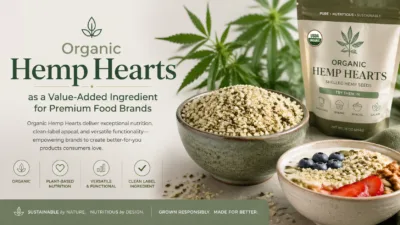
Hemp hearts (also labeled hulled or shelled hemp seeds) are the most processed form: hull completely removed, only the soft inner kernel left. Hearts run larger and softer than 3mm seeds with slightly higher fat per gram, since no hull material dilutes the weight. They shine as a topping for yogurt, oatmeal, and smoothies, and blend easily into hemp milk or sauces. HEMPLAND’s organic hemp hearts are a popular direct-to-consumer format.
3mm organic hemp seeds occupy the middle ground. They are smaller and more uniform than randomly sized hemp hearts, which makes them easier to measure and dose for baking mixes, protein bar formulations, and granola blending. The moderate size also suits seed-topping applications where you want visible seed identity without dominating the product, plus a slightly firmer bite than the soft, almost creamy texture of full hearts.
For a deeper comparison, read Hemp Seeds 3mm vs Hemp Hearts vs Whole Hemp Seeds for side-by-side nutrition tables and format recommendations.
Culinary uses for 3mm hemp seeds
In some cases the 3mm size opens a wider range of applications than either whole seeds or full hearts.
Granola and cereal blends: uniform size lets the seeds distribute evenly through a granola mix, and they cling to clusters during baking without burning thanks to their moderate size and moisture content. Manufacturers prefer the 3mm spec because it minimizes cluster size variation in the final package.
Protein bars and snack bars: pressed bar formulations take 3mm seeds smoothly into the binder matrix (dates, syrups, nut butters) without lumpy texture. Being smaller than typical nut pieces or chocolate chips, they contribute visible inclusion and texture without competing with the primary flavor.
Sprouting: with the hull gone, water penetrates easily and germination happens within 24-48 hours. Sprouted hemp seeds taste slightly sweet and nutty in salads, wraps, and sandwiches. Some manufacturers prefer 3mm over whole seeds for sprouting because germination rates are more consistent and there are no hull fragments to pick out later.
Baked goods: breads, muffins, cookies, and crackers all accept them well. Their small size means no chewy pockets in the crumb, and bakers can add them at 5-15% of flour weight for nutritional gains without changing dough handling.
Seed butter: ground, 3mm seeds produce a smooth seed butter with a greenish cast and nutty flavor, and the smaller starting size cuts grinding time. Use it as a spread on its own or blend with sunflower seed butter or tahini for a mixed-seed product.
Smoothie boost: a tablespoon adds 3 grams of protein plus healthy fats to any smoothie. The seeds blend partially, leaving slight graininess some consumers actually prefer over perfectly smooth drinks. Want it finer? Grind the seeds in a coffee grinder before adding liquid.
B2B sourcing guide for 3mm organic hemp seeds
Buying 3mm organic hemp seeds in bulk for food manufacturing, private labeling, or wholesale distribution demands attention to several specification points beyond price per kilogram.
Certification documents: organic certification (USDA NOP, EU Organic, or equivalent) must be current and must cover farm, processor, and exporter, with certificates traceable back to the certifying body. Shipments bound for the EU need the Certificate of Inspection (COI) under the EU organic import regime in place before departure. Ask to see the actual certificate rather than accepting a supplier’s claim.
Product specification sheet: a proper spec sheet lists moisture content (typically 5-8%), purity (99.5% minimum for 3mm kernels), broken kernel percentage (under 3%), foreign material (undetectable at 0.01%), and THC content (under 0.2% or 0.3% depending on market). It should also state color (light green to pale yellow-green), odor (fresh, nutty, no rancidity), and any treatment applied, such as steam pasteurization.
Minimum order quantities: bulk 3mm hemp seeds typically ship in 20-25 kg bags, with pallet loads of 500-1,000 kg as the entry point for direct-from-processor pricing. Distributors can supply smaller quantities down to 100 kg, though per-unit cost rises.
Shipping and shelf life: properly dried and packed seeds last 12-18 months stored cool, dry, and away from light. High polyunsaturated fat content makes them susceptible to oxidation, so nitrogen-flushed packaging is recommended for long-distance ocean freight. A serious supplier will provide accelerated shelf-life testing data or ongoing stability monitoring.
Pricing factors: organic 3mm hemp seed pricing moves with harvest yield, certification costs, processing throughput, and freight. Expect organic to carry a 30-50% premium over conventional hemp seed. Contracting a full season’s volume usually secures better pricing than spot purchases.
Contact Us to discuss bulk pricing, specification sheets, and current availability for organic hemp seeds 3mm from HEMPLAND.
Quality standards and testing parameters
For food safety and regulatory compliance, verify that any supplier maintains a testing program covering these parameters.
Microbiological: total aerobic plate count below 100,000 CFU/g; yeast and mold below 10,000 CFU/g; coliforms below 100 CFU/g; *E. coli* absent in 25g; *Salmonella* absent in 25g. These thresholds align with accepted standards for ready-to-eat seeds and kernels.
Heavy metals: lead below 0.1 mg/kg; cadmium below 0.5 mg/kg (hemp is known to absorb cadmium from soil, which makes this a key parameter); arsenic below 0.1 mg/kg; mercury below 0.02 mg/kg. Farm-level soil testing helps manage the cadmium risk, and suppliers should be able to explain their cadmium strategy in detail.
Mycotoxins: aflatoxin B1 below 2 μg/kg; total aflatoxins below 4 μg/kg; ochratoxin A below 5 μg/kg. Post-harvest drying is the primary control point here: seed moisture has to drop below 9% quickly after harvest to prevent mold growth.
THC and cannabinoids: total THC below 0.2% (EU standard) or 0.3% (North American standard), tested by HPLC or GC-MS. Ask for a certificate of analysis (COA) from an ISO 17025-accredited laboratory, not an in-house result.
Allergens: hemp seed itself is not among the major regulated allergens in most jurisdictions, but cross-contact with tree nuts, peanuts, soy, and gluten-containing grains can happen in shared facilities. Buyers pursuing allergen-free claims should request a documented allergen control program plus verification testing for shared equipment.
Storage and handling recommendations
Good storage protects 3mm organic hemp seed quality from receipt through production.
Temperature: store at or below 15°C (59°F) for long-term warehousing. Short-term ambient storage (20-25°C) is acceptable if the area stays cool and the seeds will be processed within 2-3 months.
Humidity: keep relative humidity below 65%. Sealed packaging until use, and partially used bags re-sealed with as little headspace air as possible.
Light exposure: light accelerates oxidation of polyunsaturated fats, so use opaque packaging or dark storage. Clear retail packs need UV-blocking film or secondary cartons until display.
Pest control: like all seeds and grains, hemp attracts stored-product pests (Indian meal moth, warehouse beetle, and relatives). An integrated pest management program combines regular pheromone-trap monitoring, strict warehouse sanitation, and temperature tracking. Fumigation generally conflicts with organic certification, so prevention carries the defense.
FIFO rotation: first-in-first-out rotation keeps older stock ahead of new arrivals. Batch codes marked on every bag should trace back to the supplier’s original processing lot.
Consumer benefits: why 3mm hemp seeds appeal to shoppers
Seen through a consumer marketing lens, 3mm organic hemp seeds tick several boxes that drive purchases in the health food segment.
Plant-based protein: at 9.5 grams per 30-gram serving, hemp seeds beat chia (4.7g), flax (5.2g), and sesame (5.0g) by a wide margin on protein density. More important, hemp protein is complete, containing all nine amino acids the body must obtain from food, something uncommon among plant foods outside soy and quinoa. Digestibility is relatively high too, with protein digestibility-corrected amino acid scores published in peer-reviewed journals.
Gluten-free and allergen-friendly: no gluten, and while allergen-free status requires a documented supply chain, hemp itself is not a regulated allergen. That opens the door to gluten-free breads, crackers, baking mixes, and cereals.
Minimal processing: a 3mm hemp seed is just a seed with its hull removed. Standard processing involves no solvents, bleaching, or chemical treatments, which fits neatly with shoppers hunting “clean label” products built on few ingredients and no processing aids.
Keto and low-carb compatibility: under 3 grams of total carbohydrates per serving plus a high fat-to-carb ratio works in ketogenic and low-carb diets, and fiber offsets part of the carbohydrate count in net-carb math.
Versatility: sprinkle, blend, bake, sprout, or grind. Unlike specialty ingredients confined to one recipe type, that flexibility drives repeat purchases because consumers keep finding new uses.
For additional reading on the health benefits of hemp, see Top 10 Health Benefits of Organic Hemp Hearts and Are Hemp Hearts Good for You?.
Regulatory considerations for 3mm hemp seeds
Rules for hemp food products have shifted significantly in recent years, particularly in North America and Europe, and buyers and sellers should know the current requirements in key markets.
United States: the 2018 Farm Bill removed hemp (defined as *Cannabis sativa* with no more than 0.3% delta-9 THC on a dry weight basis) from the Controlled Substances Act. The FDA retains authority over hemp in food, dietary supplements, and cosmetics. As of the latest available guidance, hulled hemp seed, hemp seed protein, and hemp seed oil are generally recognized as safe (GRAS) based on published notifications, and 3mm organic hemp seeds fall within the hulled seed category.
European Union: hemp food products are legal across the EU, with THC limits set at 0.2% in most member states (raised to 0.3% under the revised Common Agricultural Policy, though implementation varies by country). The EU Novel Food Catalogue lists hemp seed and hemp seed oil as having a history of consumption predating May 1997, so neither requires novel food authorization.
Canada: Health Canada regulates hemp as a food ingredient under the Cannabis Act and the Food and Drugs Act. Hulled hemp seeds and derivatives are permitted ingredients, and the THC limit for hemp food products is 10 μg/g (0.001%), stricter than the 0.3% cultivation standard, so manufacturers must test and control for it.
Import documentation: international shipments typically require a certificate of analysis, organic certificate, certificate of origin, bill of lading, packing list, commercial invoice, and sometimes a phytosanitary certificate depending on destination requirements.
Why source from HEMPLAND
HEMPLAND built its supply chain around the practical concerns of food manufacturers and brand owners.
Farm-level traceability: every batch of 3mm organic hemp seeds traces back to the farm or cooperative where the hemp was grown, which supports organic audit requirements and brand transparency claims.
Consistent sizing: specifying and verifying the 3mm fraction through calibrated screening delivers the particle size precision manufacturing processes need, with lot-to-lot variation held in a narrow range.
Documentation package: every shipment includes a batch-specific certificate of analysis from an accredited third-party laboratory, a copy of the current organic certificate, and whatever additional documentation the destination market requires.
Responsive communication: inquiry response times on bulk pricing, specifications, and shipping timelines draw consistent positive feedback from repeat buyers, and the sales team provides current harvest availability and lead times on request.
Sustainability and organic agriculture
Hemp cultivation brings environmental characteristics that line up with organic agriculture principles and sustainability marketing.
Soil health: hemp’s deep taproot improves soil structure and reduces compaction. In rotation, it contributes to soil organic matter and helps break pest and disease cycles. Rapid growth and dense canopy suppress weeds naturally, cutting mechanical cultivation passes.
Low input requirements: even conventional hemp needs fewer pesticide applications than many commodity crops, and organic hemp uses none by definition. The main agronomic challenge in organic production is weed control during early growth before canopy closure.
Water efficiency: in most growing regions hemp is not irrigated and relies on rainfall, which compares favorably with water-intensive crops like almonds and rice. The water footprint of hemp seed production concentrates in processing (cleaning, dehulling) rather than cultivation.
Carbon considerations: like every plant, hemp fixes atmospheric carbon through photosynthesis. Whether cultivation produces net carbon storage depends on soil management, residue incorporation, and the carbon cost of inputs and transport. Claims about hemp as carbon-negative deserve scrutiny against specific production data rather than blanket acceptance.
For readers interested in how hemp fits into active nutrition, Organic Hemp Hearts in Sports Nutrition covers protein timing, amino acid profiles, and recovery applications.
Conclusion
The 3mm organic hemp seed is a well-defined ingredient format serving consumer retail and food manufacturing alike. Consistent sizing, complete protein, a favorable fatty acid ratio, and clean-label credentials make it a strong candidate for brands building plant-based, high-protein, or gluten-free products.
Consumers get a convenient, minimally processed way to add protein and healthy fats to daily meals. Manufacturers get function: uniform dispersion in dry mixes, stable inclusion in bars and granolas, documented organic provenance.
HEMPLAND supplies 3mm organic hemp seeds with full documentation, tested quality parameters, and responsive service at any scale. Browse organic hemp seeds 3mm and organic hemp hearts to see current product details, then Contact Us to discuss your requirements, request a specification sheet, or place a bulk order.
Related Posts