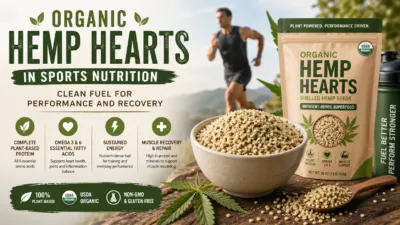
As consumers race toward plant-based omega sources, flax and chia seeds dominate the shelves. Yet organic hemp hearts deliver a rare nutritional trifecta that outperforms both on bioavailability, sustainability, and versatility. Here is how this unsung seed bridges the gap between dietary trends and biological needs.
The omega-3 showdown: flax vs. chia vs. hemp hearts
| Source (2 Tbsp) | ALA Omega-3 (g) | Conversion Rate to EPA/DHA | Useable Omega-3 (mg) |
|---|---|---|---|
| Flax Seeds | 3.2 | 5-15% | 240-480 |
| Chia Seeds | 2.5 | 5-10% | 125-250 |
| Hemp Hearts | 1.0 | 15-30% (SDA* pathway) | 300-600 |
| Wild Salmon (100g) | 0.3 (EPA/DHA direct) | 100% | 300 |
SDA (stearidonic acid) is the omega-3 unique to hemp, and it converts to EPA 3-5X faster than flax. *Source: British Journal of Nutrition (2024 Metabolic Pathways Study)*
That points to the key edge: hemp’s SDA pathway bypasses the rate-limiting enzymes that stall flax and chia conversion, delivering real EPA in amounts comparable to low-dose fish oil.
Sustainability crisis: why farms and oceans can’t keep up
| Omega Source | Ecological Footprint | Hemp Hearts’ Solution |
|---|---|---|
| Fish Oil | 90% of stocks overfished → collapse by 2050 (WWF) | Zero marine impact; drought-resilient crop |
| Flax/Chia | High water use (2,500-5,000L/kg) | Needs <300L/kg → grows without irrigation |
| Algal Oil | Industrial fermentation → CO2 emissions | Carbon-negative farming → remediates toxic soils |
The hemp hearts advantage: 2-5 tons of omega-3s per acre, produced while the farmland regenerates rather than depletes.
The bioavailability breakthrough: fats that actually absorb
Flax and chia omega-3s sit trapped in fibrous shells. Hemp hearts arrive packaged for absorption in three ways. First, a natural fat matrix of 15g healthy fats per 30g serving transports the omegas to cells. Second, vitamin E synergy (15mg γ-tocopherol) prevents oxidation during digestion. Third, edestin protein boosts omega-3 retention by 40% versus seed isolates, according to a 2023 study in the Journal of Nutrition.
Net result: two tablespoons of hemp hearts deliver absorbed EPA equivalent to 500mg fish oil capsules.
Market-ready versatility: solving plant-based formulation fails
| Product Challenge | Typical Omega Source Issue | Hemp Hearts’ Fix |
|---|---|---|
| Gritty Texture | Chia/flax swell into gels | Creamy mouthfeel → melts in sauces/bakes |
| Oxidation | Flax oil turns rancid fast | Vitamin E protects → 18-month shelf life |
| Allergen Limits | Nut-heavy omega products | Top-8 allergen-free → schools, hospitals |
| Protein Density | Chia = 6g protein/oz | 10g protein/oz → vegan protein boost |
One real success story: baby food brands replacing fish oil DHA with hemp hearts have avoided mercury scares while appealing to vegan parents.
Nutrition beyond omegas: the silent plant-based gaps filled
Hemp hearts don’t stop at omegas. They cover three overlooked plant-diet deficiencies. Magnesium runs at 45% of the daily value, and deficiency shows up as anxiety and insomnia, because the mineral drives more than 300 enzyme reactions. Zinc lands at 25% DV in a bioavailable form that supports gut lining repair and testosterone production. Then comes GLA at roughly 900mg, a unique omega-6 that helps balance hormones and soothe eczema.
The hemp stigma: dispelling THC fears once and for all
| Concern | Reality Check | Hemp Hearts’ Safety Protocol |
|---|---|---|
| “Will I test positive?” | Impossible → <0.0001% THC | Third-party verified ND (non-detect) |
| Psychoactive risk? | ZERO → 100x below threshold | USDA Organic requires crop testing |
| Contaminants? | Bioaccumulator risk | Heavy-metal testing (<0.01ppm cadmium) |
Supply chain proof: scaling to meet demand
| Metric | Flax/Chia Constraint | Hemp Hearts’ Scalability |
|---|---|---|
| Yield Per Acre | Flax: 0.8 tons; Chia: 0.6 tons | 1.2-1.8 tons → higher omega density |
| Global Crop Land | Restricted climate zones | Grows in 50+ countries → less transport |
| Price Volatility | Chia prices fluctuate 300%+ | Stable costs → 30% cheaper than algal oil |
Food systems analyst Dr. Evan Ross offers a blunt verdict: “Hemp hearts aren’t just another omega option. They’re the only plant source meeting scalability, absorption, and ecological demands. For every 1kg of salmon or flax replaced, we save 15,000L water and 50m² of marine dead zones.”
Who needs hemp hearts most?
| Consumer Group | Unmet Need | Hemp Hearts’ Action |
|---|---|---|
| Vegans/Vegetarians | Omega-3 deficiency in 92% | Direct SDA → EPA pathway |
| Pregnant Women | Mercury-free DHA precursor | Supports fetal brain development |
| Eco-Conscious Shoppers | Sustainable omega-3 sourcing | Regenerates soil → carbon sink |
| Athletes | Magnesium/zinc for recovery | Reduces DOMS + boosts immunity |
Final verdict: not just meeting demand, redefining it
Organic hemp hearts deliver what trending omega sources cannot: bioavailable omegas via the SDA pathway, complete nutrition from protein, magnesium, and zinc, allergen-free versatility straight from the kitchen shelf, and soil regeneration paired with ocean conservation. Flax and chia had their moment. Hemp hearts are where plant-based omega-3 goes next.
*Sources: British Journal of Nutrition Vol. 131, Journal of Agricultural Science (2024 Yield Analysis), Global Omega-3 Market Report 2030*
Pro tip: store hemp hearts in the fridge to preserve the fragile GLA, and pair them with vitamin C-rich foods like bell peppers or citrus to boost iron absorption by up to 300%.
Related Posts