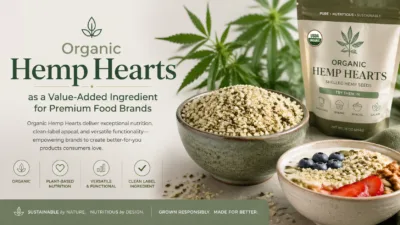
Organic hemp hearts have moved from niche health-food status to a standard line on the ingredient sheets of many premium food brands. As demand for clean-label, plant-based nutrition grows, procurement teams face real pressure to source material that clears strict quality bars without blowing up the cost sheet.
This guide walks food manufacturers, formulators, and buying specialists through what actually matters when evaluating premium organic hemp hearts. Whether you are building a plant-based dairy alternative, a high-protein snack bar, or a functional beverage, the specs below tend to decide whether a product ships on time and passes audit.
—
What are organic hemp hearts?
Organic hemp hearts are the soft, hulled inner core of the hemp seed (Cannabis sativa L.), produced after the hard outer shell is removed mechanically. Unlike whole hemp seeds, the hearts have a tender, creamy texture and none of the gritty mouthfeel that limits where whole seeds can be used.
Key nutritional profile:
- Protein: 28-35% by dry weight
- Fat: 40-45%, rich in omega-3 (alpha-linolenic acid) and omega-6 (linoleic acid)
- Omega ratio: close to the ideal 1:3 (omega-3 to omega-6)
- GLA: 1-3% (gamma-linolenic acid, rare in plant sources)
- Fiber: 6-8% (mostly insoluble)
- Minerals: magnesium, iron, zinc, potassium
For organic certification, the hemp must be grown without synthetic pesticides, herbicides, or chemical fertilizers under NOP (National Organic Program), EU Organic, or an equivalent national standard.
Recommended products:
- Organic Hemp Hearts
- Organic Hemp Seeds 3mm
—
Authentic organic certification requirements
For B2B buyers, organic certification is the baseline quality gate. Not every certificate carries the same weight in every market, though.
Recognized certification standards:
| Certification | Primary markets | Key requirements |
|---|---|---|
| USDA Organic | USA, global | 95%+ organic ingredients, NOP-compliant farming |
| EU Organic | Europe | EU 2018/848 regulation, equivalent standards |
| JAS Organic | Japan | Japanese Agricultural Standards |
| China Organic | China | CNCA accreditation |
| COSMOS Organic | Global | European natural cosmetics standard |
Verification best practices:
- Ask for the actual certificate, not just a logo on the spec sheet
- Confirm the certifying body through official registries
- Check the certificate’s validity window and scope
- Make sure the product lot number is covered
- For bulk orders, arrange a third-party audit
Warning signs:
- Self-declared “natural” or “eco” claims with no backing certificate
- Generic logos that cannot be traced to a body
- Certificates from unknown or non-accredited issuers
- Missing export documentation
—
Sensory evaluation criteria
You can grade incoming hemp hearts without a lab, if you set up a consistent inspection routine.
Color: acceptable results are creamy white to light green. Dark yellow, brown fragments, or grayish discoloration usually point to oxidation, poor storage, or aged product.
Aroma: a mild, nutty, slightly earthy scent is what you want. Rancid, paint-like, fishy, or musty odors signal lipid oxidation, microbial contamination, or bad drying.
Texture: tender, soft, buttery when chewed. Hard pieces, excess shell fragments, or a gritty feel mean incomplete dehulling, poor processing, or moisture problems.
Storage stability test:
- Heat a small sample to 40°C and check for off-odors
- Watch color changes over 48 hours at room temperature
- This accelerated test gives a read on shelf stability
—
Technical specifications and COAs
B2B purchasing needs a spec sheet and a Certificate of Analysis (COA) for every batch.
Standard specification sheet:
| Parameter | Specification | Test method |
|---|---|---|
| Protein (dry basis) | 28-35% | AOAC 991.20 |
| Moisture | <6% | AOAC 925.10 |
| Ash | <5% | AOAC 942.05 |
| Fat | 40-45% | AOAC 991.36 |
| Fiber | 6-8% | AOAC 991.43 |
| THC | <10 mg/kg (<0.001%) | GC-MS |
| Cadmium | <0.1 mg/kg | ICP-MS |
| Lead | <0.1 mg/kg | ICP-MS |
| Arsenic | <0.1 mg/kg | ICP-MS |
| Mercury | <0.1 mg/kg | ICP-MS |
| Total plate count | <10,000 cfu/g | ISO 4833 |
| Yeast and mold | <100 cfu/g | ISO 7954 |
| E. coli | <10 cfu/g | ISO 16649 |
Heavy metal limits vary by market. The EU is especially strict on cadmium (0.1 mg/kg) in hemp seeds, so confirm the COA matches your target market’s requirements.
—
Origin and supply chain considerations
Major producing regions:
- China (Inner Mongolia, Yunnan): year-round supply, competitive pricing, established organic farming. Watch export documentation and shipping lead times of 3-6 weeks.
- Canada: high quality standards and a strong regulatory framework, but seasonal availability, premium pricing, and shorter shelf life on arrival.
- Europe (France, Romania): EU Organic certification and proximity to European markets, at higher cost and limited scale.
- United States: domestic supply and fast logistics, but limited organic acreage and higher labor costs.
Supplier evaluation checklist:
- Current, verified organic certifications
- Processing facilities (hulling, cleaning, optical sorting)
- Quality management systems (ISO, HACCP, BRC)
- Testing capability (in-house versus third-party)
- Production capacity and scalability
- Minimum order quantities
- Lead times and inventory availability
- Export documentation experience
- Payment terms and credit facilities
- References from comparable industries
—
Packaging and shelf life optimization
Packaging requirements for B2B:
- Material: multi-layer kraft paper with an aluminum barrier, or vacuum-sealed bags
- Features: nitrogen flushing, oxygen absorbers, resealable closures
- Sizes: 5 kg, 10 kg, 20 kg, 25 kg bags (customizable)
- Labeling: batch number, best-by date, COA reference, storage instructions
Shelf life factors:
- Typical shelf life runs 12-18 months from production
- Degradation accelerates above 20°C
- Light exposure increases oxidation
- Humidity encourages microbial growth
Storage recommendations:
- Temperature below 20°C (refrigeration preferred for long storage)
- Humidity below 65% relative humidity
- Light: opaque or dark containers
- Atmosphere: nitrogen-flushed or vacuum-sealed
- Separation: keep away from strong-odor products to avoid cross-contamination
—
Application-specific selection criteria
Different products need different hemp heart specs.
For protein powders and supplements: high protein (above 30%), fine particle size for a smooth texture, neutral flavor, and minimal shell fragments.
For snack bars and confectionery: consistent white or cream color, whole hearts for visual appeal, good binding properties, and moisture stability.
For plant-based dairy alternatives: neutral flavor, smooth texture, high dispersibility, and clean-label compatibility.
For baking: heat-stable varieties, consistent particle size, and a neutral flavor that supports the rest of the formulation.
For sports nutrition: high protein and BCAA content, fast dispersing, and a clean label position.
—
B2B procurement best practices
Sample evaluation process:
- Request 1-5 kg samples from shortlisted suppliers
- Run sensory evaluation within 48 hours of receipt
- Commission lab testing on the key parameters
- Test in your actual formulations where possible
- Check packaging and labeling compliance
- Confirm documentation is complete
Negotiation points:
- Volume commitments in exchange for price reductions
- Reserved inventory for steady supply
- Exclusive formulations for differentiation
- Custom processing specifications
- Payment terms and credit facilities
Risk mitigation:
- Maintain relationships with multiple suppliers
- Hold buffer inventory (4-8 weeks)
- Build in quality guarantees and liability clauses
- Set insurance requirements
—
Conclusion
Sourcing premium organic hemp hearts rewards a systematic approach: verify certification, run sensory checks, review the technical spec, and do the supply chain due diligence. Buyers who follow a consistent protocol like the one above end up with reliable sourcing and fewer surprises at audit.
For businesses buying at volume, HEMPLAND supplies organic hemp hearts with custom specifications, flexible minimum order quantities, full documentation, and global shipping. The hearts meet the selection criteria outlined above, freshly shelled, properly stored, and backed by certificates of analysis.
—
Recommended Products

Organic Hemp Seeds
Organic hemp seeds offer complete nutrition with optimal protein, fatty acids, and fiber content.…
Related Posts