
The global hemp seed oil market has experienced significant growth as food manufacturers and cosmetic companies recognize its unique nutritional profile and functional properties. However, selecting between cold-pressed and refined organic hemp seed oil requires understanding their distinct characteristics, applications, and quality considerations.
This professional guide provides B2B procurement specialists, formulators, and quality managers with comprehensive technical data to make informed sourcing decisions for food manufacturing, cosmetic formulations, and supplement production.
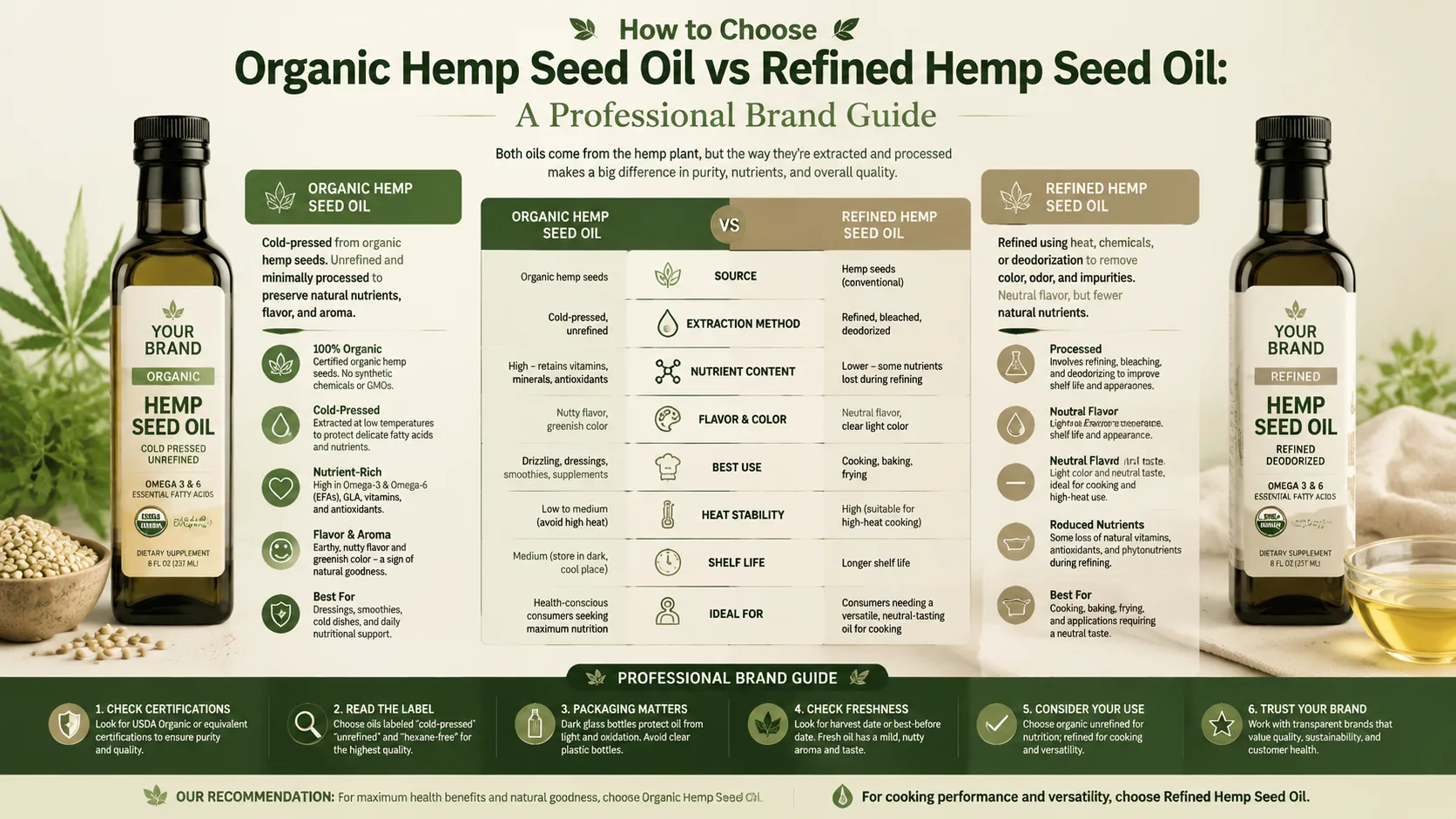
Understanding Extraction Methods
Cold-Press Extraction
Cold-pressing involves mechanically crushing hemp seeds at temperatures below 40°C (104°F) to extract oil without chemical processing. This method preserves the oil’s natural nutritional profile and characteristic properties:
Process Characteristics:
- Temperature: <40°C throughout extraction
- Yield: 25-35% oil recovery from seeds
- Processing time: Continuous or batch pressing
- Post-processing: Simple filtration only
- Additives: None
Preserved Components:
- Natural tocopherols (Vitamin E): 90-100% retained
- Chlorophyll: Present (greenish color)
- Plant sterols: 85-95% retained
- Carotenoids: Natural levels preserved
- Minor phytonutrients: Intact
Refined Extraction
Refined hemp seed oil undergoes additional processing to remove color, flavor, and extend shelf life. This typically includes:
Process Stages:
- Degumming: Removal of phospholipids using water or acid
- Neutralization: Chemical or physical removal of free fatty acids
- Bleaching: Adsorbent treatment to remove pigments
- Deodorizing: Steam distillation to remove volatile compounds
- Winterization: Optional removal of waxes
Resulting Properties:
- Color: Clear, pale yellow to water-white
- Flavor: Neutral, no characteristic hemp taste
- Shelf stability: Significantly extended
- Smoke point: Increased to 200-220°C
Fatty Acid Composition Comparison
Both oil types maintain similar core fatty acid profiles, but cold-pressed preserves more of the minor but important fatty acid fractions.
Standard Fatty Acid Profile:
| Fatty Acid | Cold-Pressed | Refined | Significance |
|---|---|---|---|
| Linoleic Acid (Omega-6) | 50-60% | 52-60% | Essential fatty acid |
| Alpha-Linolenic Acid (Omega-3) | 15-20% | 12-18% | Essential fatty acid |
| Oleic Acid (Omega-9) | 10-15% | 12-16% | Monounsaturated |
| Gamma-Linolenic Acid (GLA) | 1-3% | 0.5-2% | Anti-inflammatory |
| Stearic Acid | 2-3% | 2-3% | Saturated fat |
| Palmitic Acid | 5-8% | 6-8% | Saturated fat |
Critical Difference: Vitamin E Content
| Form | Cold-Pressed | Refined | Health Implication |
|---|---|---|---|
| Alpha-tocopherol | 40-50 mg/100g | 15-25 mg/100g | Antioxidant protection |
| Gamma-tocopherol | 80-100 mg/100g | 30-50 mg/100g | Cardiovascular support |
| Delta-tocopherol | 5-10 mg/100g | 2-5 mg/100g | Minor antioxidant |
Quality Specifications for B2B Procurement
Cold-Pressed Organic Hemp Seed Oil Specifications
Quality Parameters:
| Parameter | Specification | Test Method | Notes |
|---|---|---|---|
| Free Fatty Acids (FFA) | <2.0% | AOCS Cd 3d-63 | Lower is better |
| Peroxide Value (PV) | <10 meq/kg | AOCS Cd 8-53 | Freshness indicator |
| Iodine Value | 150-175 g/100g | AOCS Cd 1-25 | Saturation level |
| Moisture | <0.2% | AOCS Ca 2c-25 | Water content |
| Chlorophyll | 5-20 ppm | Spectrophotometric | Color indicator |
| Vitamin E | >40 mg/100g | HPLC | Nutritional marker |
Sensory Specifications:
- Color: Golden yellow to light green
- Odor: Mild, nutty, characteristic hemp aroma
- Taste: Nutty, fresh, no rancidity
- Clarity: Clear, no sediment
Refined Organic Hemp Seed Oil Specifications
Quality Parameters:
| Parameter | Specification | Test Method | Notes |
|---|---|---|---|
| Free Fatty Acids (FFA) | <0.1% | AOCS Cd 3d-63 | Premium quality |
| Peroxide Value (PV) | <5 meq/kg | AOCS Cd 8-53 | Excellent freshness |
| Color (Lovibond) | 5-15R max | AOCS Cc 13b-45 | Bleaching quality |
| Unsaponifiable Matter | <1.5% | AOCS Ca 6a-40 | Purity indicator |
| Moisture | <0.05% | Karl Fischer | Very low water |
| Iron | <1.5 ppm | ICP-MS | Contamination check |
| Copper | <0.1 ppm | ICP-MS | Contamination check |
Application Recommendations
Food Manufacturing Applications
Cold-Pressed Hemp Seed Oil:
| Application | Suitability | Notes |
|---|---|---|
| Salad Dressings | Excellent | Flavor enhancement, premium positioning |
| Finishing Oil | Excellent | Drizzle on finished dishes |
| Smoothies | Good | Nutritional boost |
| dips | Good | Flavor carrier |
| Baking (low-temp) | Fair | Limited heat applications |
| Cooking/Frying | Not suitable | Low smoke point |
| Confectionery | Good | Premium chocolate coatings |
| Supplements | Excellent | Softgel encapsulation |
Refined Hemp Seed Oil:
| Application | Suitability | Notes |
|---|---|---|
| Cooking/Frying | Good | Higher smoke point |
| Baking | Good | Neutral flavor doesn’t compete |
| Processed Foods | Excellent | Consistent results |
| Margarine | Excellent | Stability requirements met |
| Confectionery | Good | No flavor interference |
| Supplement Carriers | Fair | Less vitamin E but stable |
| Marinades | Good | Holds up to processing |
Cosmetic and Personal Care Applications
Cold-Pressed Hemp Seed Oil:
| Application | Suitability | Notes |
|---|---|---|
| Premium Skin Oils | Excellent | Anti-aging positioning |
| Hair Care | Excellent | Moisture and shine |
| Massage Oils | Excellent | Skin-nourishing |
| Natural Cosmetics | Excellent | Clean beauty positioning |
| Premium Serums | Excellent | GLA benefits for skin |
Refined Hemp Seed Oil:
| Application | Suitability | Notes |
|---|---|---|
| Industrial Cosmetics | Excellent | Consistent batch-to-batch |
| Baby Care | Good | Mild formulation base |
| Sensitive Skin Products | Good | Low irritation potential |
| Body Lotions | Good | Stable formulation base |
Storage and Shelf Life Management
Cold-Pressed Oil Storage
Critical Storage Requirements:
- Temperature: 4-10°C (refrigerated)
- Light protection: Opaque containers essential
- Oxygen exclusion: Nitrogen flushing recommended
- Container material: Dark glass, stainless steel, or coated steel
- Headspace: Minimal (<5% of container volume)
Shelf Life Parameters:
- Guaranteed shelf life: 12 months refrigerated
- Optimal quality period: 6-8 months
- Quality degradation indicators: Rancidity odor, color darkening, sediment formation
Refined Oil Storage
Moderate Storage Requirements:
- Temperature: 15-20°C (cool, dark)
- Light protection: Standard containers acceptable
- Oxygen exclusion: Sealed containers sufficient
- Container material: Stainless steel, food-grade plastic
- Headspace: Minimal preferred
Shelf Life Parameters:
- Guaranteed shelf life: 18-24 months
- Quality stability: Maintains specification longer
- Quality degradation: Slower oxidation process
Regulatory and Certification Requirements
Required Certifications for B2B
| Certification | Market | Priority |
|---|---|---|
| USDA Organic | USA, Global | Mandatory |
| EU Organic | Europe | Mandatory |
| Kosher | Global (Jewish market) | Recommended |
| Halal | Muslim markets | Recommended |
| FSSC 22000 | Global food safety | Recommended |
| BRC Global Standard | UK, Global retailers | Recommended |
Regulatory Limits by Market
European Union:
- THC limit in food: <0.0% (not detectable)
- Cadmium in hemp oil: <0.05 mg/kg
- Peroxide value: <10 meq/kg at release
- FFA: <2% for cold-pressed
United States:
- THC limit: <0.3% THC in final product
- GRAS status: Generally Recognized as Safe
- FDA: No specific hemp oil regulations beyond standard food oils
Canada:
- THC limit: <10 ppm in food
- Novel Food classification: Not required for hemp seed oil
- CFIA: Standard food oil regulations apply
Supplier Evaluation Criteria
Technical Capability Assessment:
| Criteria | Weight | Evaluation Method |
|---|---|---|
| Extraction technology | High | Facility audit |
| Quality control systems | High | Certification review |
| Batch consistency | High | Sample testing |
| Capacity/scalability | Medium | Production capability review |
| Documentation | High | COA and spec sheet review |
| Supply chain reliability | High | Reference checks |
Required Documentation Package:
- Certificate of Analysis (COA) per batch:
- FFA, PV, moisture, color
- Fatty acid profile
- Heavy metal testing
- Pesticide residue
- Microbiological testing
- Organic Certificates:
- Current organic certification
- Organic System Plan compliance
- Transaction certificates per shipment
- Technical Specifications:
- Product specification sheet
- Material Safety Data Sheet (MSDS)
- Shelf life documentation
- Storage recommendations
- Business Documentation:
- References from similar industries
- Financial stability evidence
- Insurance coverage
- Liability guarantees

Conclusion
Selecting between organic cold-pressed and refined hemp seed oil requires balancing product positioning, application requirements, shelf life needs, and budget constraints. Both varieties serve distinct market needs and can form complementary product lines.
Key Decision Framework:
- Choose Cold-Pressed for:
- Premium, artisanal positioning
- Clean-label claims
- Nutritional superiority messaging
- Short-term storage capability
- Premium pricing strategy
- Choose Refined for:
- Industrial manufacturing scale
- Extended shelf life requirements
- Neutral flavor needs
- Consistent batch specifications
- Cost-optimized formulations
For B2B buyers seeking premium organic hemp seed oils, HEMPLAND offers both cold-pressed and refined options with comprehensive certifications, flexible MOQ, and global logistics support. HEMPLAND offers both organic cold-pressed and refined hemp seed oil, with detailed specification sheets to help brands make informed sourcing decisions.