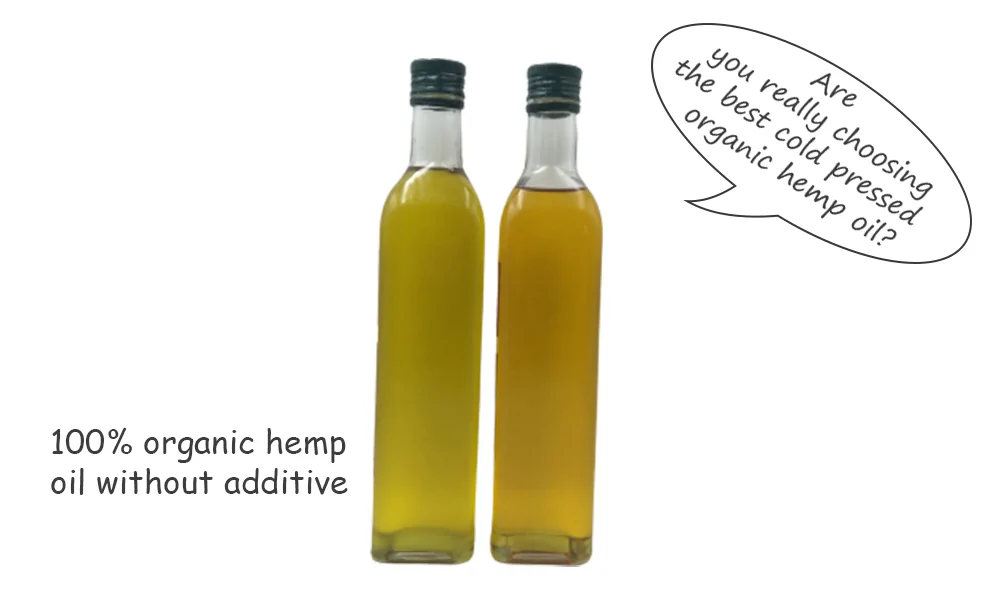
How to Choose the Best Cold-Pressed Organic Hemp Seed Oil: A Buyer’s Guide to Green vs. Golden, Quality Standards, and Sourcing Best Practices
12 minutes of reading
Not all cold-pressed organic hemp seed oils are created equal. The market offers two fundamentally distinct product categories — green hemp seed oil (pressed from whole seeds) and golden hemp seed oil (pressed from dehulled hemp hearts / kernels) — each with different nutritional profiles, sensory characteristics, by-product economics, and end-use suitability. This guide provides a systematic framework for buyers and formulators to evaluate, compare, and select the right cold-pressed organic hemp seed oil for their specific application. We examine the technical differences between green and golden oils, analyze the cold-pressing process in detail, benchmark hemp seed oil against other edible vegetable oils, establish quality criteria for sourcing decisions, and provide a practical decision matrix for food, cosmetic, and supplement manufacturers.
Key Findings:
Green hemp seed oil is pressed from whole seeds (with hulls), producing dark green oil rich in chlorophyll but carrying higher heavy metal risk; its by-product is green/brown protein powder (~50% protein, limited solubility).
Golden hemp seed oil is pressed from dehulled hemp hearts, yielding pale golden oil with neutral flavor and superior safety; its by-product is white protein powder (up to 80% protein, excellent water solubility).
The omega-6 to omega-3 ratio of ~2.5:1–3:1 in hemp seed oil is among the most favorable of any edible oil, aligning closely with WHO recommendations of 2:1–4:1.
Cold pressing at ≤40°C preserves thermolabile nutrients including tocopherols, phytosterols, and polyunsaturated fatty acids that would be degraded or lost in solvent extraction or high-temperature refining.
Quality selection requires evaluation across six dimensions: raw material origin, processing method, fatty acid profile, purity testing (THC/heavy metals/pesticides), sensory attributes, and regulatory certification.
Cold pressing is a mechanical oil extraction technology in which raw material is subjected to controlled pressure at low temperature — not exceeding 40°C (104°F) — without chemical solvents, bleaching agents, or heat treatment. For hemp seed oil production, cold pressing is considered the gold standard because it:
Benefit
Mechanism
Outcome
Nutrient preservation
No thermal degradation of PUFA, tocopherols, or phytosterols
Maximum retention of omega fatty acids, vitamin E, bioactive compounds
No solvent residue
Physical extraction only
No hexane, petroleum ether, or other chemical residues
Natural flavor & color
Minimal processing intervention
Characteristic nutty flavor and natural pigments preserved
Organic compliance
No synthetic chemicals used
Meets USDA/EU organic processing standards
Non-GMO integrity
No genetic modification involved
Maintains non-GMO status throughout
1.2 Two Categories of Cold-Pressed Hemp Seed Oil
The most critical distinction in the hemp seed oil market — and one that many buyers overlook — is the difference between green hemp seed oil and golden (yellow) hemp seed oil:
Dimension
Green Hemp seed Oil
Golden (Yellow) Hemp Seed Oil
Raw Material
Whole hemp seeds (intact with hulls/shells)
Dehulled hemp hearts (shelled inner kernel)
Color
Dark green (chlorophyll from hulls)
Pale golden / light yellow
Flavor
Strong, grassy, bitter
Mild, nutty, neutral
Chlorophyll Content
High (100–500 mg/kg)
Negligible (<5 mg/kg)
Heavy Metal Risk
Higher (hulls concentrate metals)
Very low (hulls removed)
Oxidative Stability
Lower (chlorophyll acts as pro-oxidant under light)
Higher (no chlorophyll)
By-Product
Green/brown protein powder (~50% protein, poor solubility)
White protein powder (~70–80% protein, excellent solubility)
Historically, green hemp seed oil has commanded the majority of market share for two primary reasons:
Technological inertia: Early hemp seed oil producers lacked dehulling equipment and pressed whole seeds directly. This established the green-oil standard for decades, creating entrenched supply chains and consumer expectations.
Perceptual bias: Many consumers associate green color with healthfulness (“green = natural = healthy”), overlooking that chlorophyll in oil actually accelerates oxidation and reduces shelf stability.
As processing capabilities advance and formulators demand higher-quality ingredients for sensitive applications (infant nutrition, premium cosmetics, clean-label products), golden hemp seed oil is gaining significant market traction.
2. Fatty Acid Profile: How Hemp Seed Oil Compares
2.1 Comprehensive Vegetable Oil Comparison
The nutritional superiority of hemp seed oil lies primarily in its unique fatty acid composition. Below is a comprehensive comparison against other common edible oils:
The World Health Organization recommends an omega-6 to omega-3 dietary ratio between 2:1 and 4:1 for optimal cardiovascular and inflammatory health. The modern Western diet typically delivers ratios of 15:1 to 20:1 — a severe imbalance linked to chronic inflammation, cardiovascular disease, metabolic syndrome, and autoimmune conditions.
Oil
ω-6:ω-3 Ratio
Alignment with WHO Target
Implication
Hemp Seed Oil
2.5:1–3:1
✅ Excellent
One of the few naturally balanced sources
Canola Oil
~2:1
✅ Good
Balanced, but lacks GLA
Flaxseed Oil
0.2:1 – 0.3:1
⚠️ Too low on ω-6
Excessive ω-3 alone may be suboptimal
Olive Oil
>10:1
❌ Excess ω-6 relative to ω-3
Not an omega-3 source
Soybean Oil
~7:1
❌ Above target
Common but imbalanced
Sunflower Oil
>50:1
❌ Severely imbalanced
Pro-inflammatory profile
2.3 The Unique Value of GLA
Gamma-linolenic acid (GLA), present in hemp seed oil at 1–4%, is a rare omega-6 fatty acid not found in most common edible oils. Its significance lies in its metabolic pathway:
Unlike linoleic acid (LA), which can be pro-inflammatory when consumed in excess, GLA is converted directly into dihomo-gamma-linolenic acid (DGLA) — a precursor to anti-inflammatory series-1 prostaglandins
GLA bypasses the delta-6-desaturase enzyme step that is often impaired in aging populations and individuals with chronic disease
Clinical studies support GLA’s efficacy in managing eczema, rheumatoid arthritis, diabetic neuropathy, and PMS symptoms
Among commonly available food-grade oils, only hemp seed oil, evening primrose oil, borage oil, and black currant seed oil contain meaningful GLA levels — making hemp seed oil uniquely positioned as both a culinary oil and a functional ingredient
3. By-Product Economics: Protein Powder Quality
A critical but frequently overlooked factor in selecting hemp seed oil is the quality of the press cake by-product. The type of oil produced determines the quality and commercial value of the co-produced protein powder:
Food-grade supplement manufacturers, plant-based protein brands
3.2 Economic Implications for Buyers
For integrated operations that produce both oil and protein powder, the choice of green vs. golden oil production has direct economic consequences:
Golden oil production yields higher-value white protein powder that commands premium pricing in the sports nutrition and plant-based meat markets
Green oil production produces lower-value brown/green protein powder suitable primarily for animal feed applications
China is currently the dominant producer of high-protein white hemp protein powder (70–80%), leveraging advanced dehulling and cold-pressing infrastructure
As the global plant-based protein market grows (projected $28B USD by 2030), the economic advantage of golden oil + white protein production becomes increasingly compelling
4. How Cold-Pressed Organic Hemp Seed Oil Is Made
4.1 Production Flow Chart
Stage
Process
Temperature
Purpose
Key Output
1. Raw Material Selection
Certified organic whole hemp seeds
Ambient
Verify origin, moisture, maturity
Clean, graded whole seeds
2. Cleaning & Sorting
Air classification, destoning
<30°C
Remove debris, immature seeds, foreign matter
Pure, uniform seeds
3. Dehulling(golden oil only)
Mechanical impact hull removal
<35°C
Separate kernel from shell
Hemp hearts + separated hulls
4. Conditioning(optional)
Gentle warming to improve oil yield
≤40°C
Soften seed structure for pressing
Conditioned seeds/hearts
5. Cold Pressing
Screw press or expeller press
≤40°C (strictly controlled)
Mechanical extraction of oil
Crude oil + press cake
6. Primary Filtration
Mesh filtration / centrifugal separation
<25°C
Remove suspended solids
Clarified crude oil
7. Settling
Static settling tank
15–20°C
Allow fine particulates to settle
Refined clarity oil
8. Nitrogen Flushing
Inert gas blanketing
Ambient
Displace oxygen in headspace
Oxidation-protected finished oil
9. Packaging
Amber glass / opaque HDPE / stainless steel drums
Ambient
Protect from light and oxygen
Finished packaged product
10. QC Testing
CoA generation per batch
N/A
Verify all specifications meet standard
Certificate of Analysis
4.2 Critical Control Points (CCPs)
Each stage contains critical parameters that must be monitored and documented:
CCP
Parameter
Specification
Monitoring Method
Corrective Action if Out-of-Spec
Dehulling efficiency
Hull removal rate
≥95%
Weight analysis of hull fraction
Adjust dehulling settings; re-process
Pressing temperature
Oil outlet temperature
≤40°C
Continuous infrared thermometer
Reduce screw speed; increase cooling
Acid value
Free fatty acid content
<2.0 mg KOH/g
Titration (per batch)
Reject batch; investigate storage conditions
Peroxide value
Primary oxidation indicator
<5.0 meq O₂/kg
Titration (per batch)
Discard if >10; nitrogen-flush if marginal
Moisture content
Water in final oil
<0.1%
Karl Fischer titration
Re-dry or reject
THC content
Cannabinoid level
<2 ppm (<0.0002%)
HPLC/LC-MS (per batch)
Reject; trace source contamination
Heavy metals
Pb, Cd, As, Hg total
Within Codex limits
ICP-MS (per batch)
Reject; investigate soil/source
5. Quality Selection Framework
5.1 Six-Dimensional Evaluation Matrix
To systematically select the best cold-pressed organic hemp seed oil for your application, evaluate each supplier across these six dimensions:
Dimension 1: Raw Material Origin & Certification
Criterion
Ideal Specification
Why It Matters
Organic Certification
USDA Organic AND EU Organic
Dual certification ensures global market access and highest production standards
Non-GMO Status
Verified non-GMO (PCR negative)
Consumer expectation; regulatory requirement in some markets
Seed Variety
Approved industrial hemp cultivar
Ensures consistent oil profile and THC compliance
Geographic Origin
Documented farm/region traceability
Enables supply chain transparency and quality control
All oils cold-pressed at ≤40°C with continuous temperature monitoring
THC tested every batch: confirmed <2 ppm
Dual organic certification: USDA Organic + EU Organic (where applicable)
Full CoA provided: fatty acid profile, contaminants, sensory, microbiology
Traceability: from certified field to finished drum — fully documented
Nitrogen-flushed packaging: extends shelf life and protects freshness during transit
References
Callaway, J. C. (2004). Hempseed as a nutritional resource: An overview. Euphytica, 140(1–2), 65–72. https://doi.org/10.1007/s10681-004-4811-9
Oomah, B. D., Busson, M., Godfrey, D. V., & Drover, J. C. (2002). Characteristics of hemp (Cannabis sativa L.) seed oil. Food Chemistry, 76(1), 33–43. https://doi.org/10.1016/S0308-8146(01)00245-X
Simopoulos, A. P. (2002). The importance of the ratio of omega-6/omega-3 essential fatty acids. Biomedicine & Pharmacotherapy, 56(8), 365–379. https://doi.org/10.1016/S0753-3322(02)00253-6
World Health Organization. (2008). Interim summary of conclusions and dietary recommendations on total fat & fatty acids. WHO Technical Report Series 922.
Farinon, B., Molinari, R., Costantini, L., & Merendino, N. (2020). The seed of industrial hemp (Cannabis sativa L.): Nutritional quality and potential functionality for human health and nutrition. Nutrients, 12(7), 1935. https://doi.org/10.3390/nu12071935
Leonard, W., Zhang, P., Ying, D., & Fang, Z. (2020). Hempseed in food industry: Nutritional value, health benefits, and industrial applications. Comprehensive Reviews in Food Science and Food Safety, 19(1), 282–308. https://doi.org/10.1111/1541-4337.12517
Leizer, C., Ribnicky, D., Poulev, A., Dushenkov, S., & Raskin, I. (2000). The composition of hemp seed oil and its potential as an important source of nutrition. Journal of Nutraceuticals, Functional & Medical Foods, 2(4), 35–53. https://doi.org/10.1300/J133v02n04_04
Schwab, U. S., Callaway, J. C., Erkkilä, A. T., et al. (2006). Effects of hempseed and flaxseed oils on the profile of serum fatty acids in healthy adults. Prostaglandins, Leukotrienes and Essential Fatty Acids, 74(1), 11–18. https://doi.org/10.1016/j.plefa.2005.08.002
Zietsman, A. J., NonNull, N. P., & Zhao, Y. (2020). High-pressure processing of hemp (Cannabis sativa L.) seed oil: Impact on bioactive lipids. Food Research International, 137, 109637. https://doi.org/10.1016/j.foodres.2020.109637
House, J. D., Neufeld, J., & Leson, G. (2010). Evaluating the quality of protein from hemp seed (Cannabis sativa L.) products through the use of the protein digestibility-corrected amino acid score method. Journal of Agricultural and Food Chemistry, 58(22), 11801–11807. https://doi.org/10.1021/jf102536f
Disclaimer: This article is provided for informational and educational purposes only. All nutritional data, technical specifications, price indications, and regulatory information cited are derived from published scientific literature, industry standards, and publicly available market intelligence as of the publication date. Actual values may vary by cultivar, growing region, processing conditions, and supplier-specific practices. Price indications are approximate wholesale estimates and do not constitute binding quotations. This content does not constitute medical advice, legal counsel, or investment guidance. Food and cosmetic manufacturers must conduct independent validation, stability testing, and regulatory verification before incorporating hemp seed oil into commercial products.
Ready to Transform Your Hemp Experience?
Contact us today to learn how our integrated hemp solutions can benefit your business.