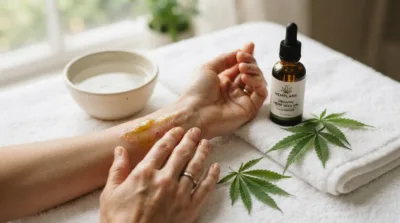
Hemp seed oil has moved from health food shelves into mainstream skincare, and unlike a fair number of ingredient trends it has a reasonable basis. The oil is high in linoleic acid, the fatty acid most involved in keeping the skin barrier working, and it is light enough to use on the face without feeling heavy. It will not treat acne, reverse ageing, or do anything that would require a drug to achieve. What it does is support the barrier, calm the look of dryness, and sit well under other products. Used consistently for a few weeks it is a genuinely good addition to a simple routine, and the main skill involved is using less of it than you think.
Why hemp seed oil works for skin
The case for hemp seed oil rests mostly on one number. Roughly fifty to sixty per cent of its fat is linoleic acid, an omega-6 fatty acid that the body cannot make and that is a structural component of the ceramides holding the outer layer of skin together.
That matters because skin low in linoleic acid tends to be dry, flaky, and more reactive. Research going back several decades found that people with acne often have lower linoleic acid levels in their skin surface lipids, and that topical application can help normalise it. The effect is modest and it is not a treatment, but the mechanism is real and it is specific rather than generic moisturising.
The rest of the profile supports it. Alpha-linolenic acid contributes to the same barrier function from the omega-3 side, and gamma-linolenic acid, present in small amounts, is involved in the signalling that governs inflammatory response. Hemp also contains tocopherols, which is a formal way of saying it carries a little natural vitamin E, and that slows oxidation both in the bottle and on the skin.
What it does for a balanced complexion
Balanced is a vague word, so it is worth being concrete about what changes and what does not.
What it does: reduce the tight, flaky feeling that follows cleansing; soften the appearance of dry patches; give a slight plumpness that makes fine dehydration lines less obvious; and leave a finish that is dewy rather than greasy. Most people notice the improvement in comfort within a week and the visible change within three to four.
What it does not do: clear acne, fade pigmentation, stimulate collagen, or change pore size. It is also not a substitute for sunscreen, which is the single intervention with the strongest evidence for how skin ages. Anyone selling hemp oil on anti-ageing claims is overstating what a seed oil can do.
There is one genuine caution. Oil alone does not moisturise; it slows water loss. Applying it to dry skin seals in very little. It works best layered over something water-based, or applied to damp skin, because then there is actually water there to hold onto.
How to fit it into a routine
Where you put it depends on what else you use. The general principle is to apply products from thinnest to thickest, and an oil goes near the end.
- After cleansing, while skin is still slightly damp
- After any water-based serum or hydrating toner
- Before or mixed into your moisturiser, depending on how dry you are
- Under sunscreen in the morning, giving it a minute to settle first
Two to three drops is enough for the whole face. Warm them between your palms and press, rather than rubbing, which reduces dragging. If your skin still looks shiny after five minutes, you have used too much, and blotting with a tissue fixes it.
It layers well with most things, including niacinamide, hyaluronic acid, and retinoids, where a light oil underneath can reduce the flaking that retinoids cause in the first weeks. The combination to be careful with is layering oil under a product that needs to absorb into bare skin, since the oil will slow that down.
A simple night step
The easiest way to try it without restructuring anything is to add it as the last step at night.
Cleanse as usual, apply whatever hydrating product you normally use, then press two or three drops of cold-pressed hemp seed oil over the top. Give it a few minutes before your pillow. In the morning, cleanse as normal, and use sunscreen during the day as usual.
For very dry areas, or in winter, mixing a drop into your moisturiser in the palm of your hand works better than layering it on top. For oilier skin, use it only on the cheeks and anywhere that feels tight, and leave the T-zone alone. If you are using a treatment such as a retinoid or an acid, keep the oil to the nights you are not using it, at least until you know how your skin responds.
Who should try it
Hemp seed oil suits dry, dehydrated, and generally reactive skin best, which is the group most likely to be low in linoleic acid and to notice the difference.
Combination and oily skin can use it too, and the linoleic acid content is precisely why it is often recommended for breakout-prone skin, since it is relatively light and does not sit heavily in pores. Start with a drop or two on the cheeks and see how it goes over two weeks.
The group that should be careful is anyone with a known seed allergy, and anyone with very congestion-prone skin should patch test first. Apply a small amount to the jaw or behind the ear for three nights before putting it on your whole face. And if you have persistent acne, rosacea, or dermatitis, see a dermatologist rather than trying to manage it with oil; hemp seed oil can be a useful adjunct to treatment, not a replacement for it.
Q: Can hemp seed oil clog pores?
It is considered low risk, and lower than many heavier plant oils. Hemp seed oil is relatively high in linoleic acid and low in oleic acid, and that ratio is associated with oils that are less likely to contribute to congestion. Individual skin varies, though, and any oil can sit badly on some people. Patch test on a small area for a few nights, use only two or three drops, and stop if you notice more congestion rather than less after two weeks.
Q: Should I use it morning or night?
Either works, and most people prefer night because an oil takes a little time to settle and can affect how makeup sits. Used in the morning, two drops pressed in after your serum and before sunscreen is fine, and it gives a dewy finish under makeup if you give it five minutes. Used at night it has longer to work and no sunscreen to interfere. There is no functional difference, so use it whenever you will actually remember to.
Q: Is it the same as CBD oil?
No, and the confusion is common enough to be worth stating plainly. Hemp seed oil is pressed from the seed and contains cannabinoids only in trace amounts; it is a fatty-acid source that supports the skin barrier. CBD oil is extracted from the flowers and leaves and acts on the endocannabinoid system. They are different products from different parts of the same plant, with different compositions and different regulatory positions. If a hemp seed oil is marketed with CBD-style claims, the label is trading on the ambiguity.
Recommended Products

Organic Hemp Seed Oil
Premium organic hemp seed oil — cold-pressed, virgin & extra virgin grades. Perfect 3:1…
Related Posts