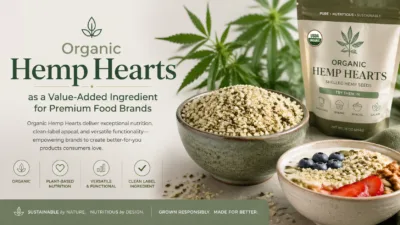
The top 10 health benefits of organic hemp hearts trace back to four facts: 31.6 g protein per 100 g, a 3:1 omega-6 to omega-3 ratio, 700 mg magnesium, and a mild flavour that needs no masking. For formulators the real question is which benefits are defensible on-label and which belong in the marketing deck. What follows maps each benefit to its nutrient basis, with formulation notes for bars and dairy alternatives.
The short version: organic hemp hearts contribute to daily protein intake, supply all nine essential amino acids, support essential fatty acid intake, help maintain normal blood cholesterol, and support skin barrier function. They also back normal muscle and nerve function via magnesium, plant-based iron intake, and normal immune function via zinc. Add better tolerance than whole seed plus clean-label, allergen-friendly positioning, and each of the ten points ties to a nutrient on the spec table below.
What are organic hemp hearts?
Hemp hearts are the shelled kernels of *Cannabis sativa* L. seed. The hull is removed mechanically: no solvent, no cannabinoid extraction.
Dehulling concentrates nutrition to roughly 31-32 g protein and 48-49 g fat per 100 g, carried by edestin and albumin.
Organic hemp hearts contain all nine essential amino acids, though lysine sits below reference patterns. That gap is why “complete spectrum” is accurate and “equivalent to whey” is not.
Flavour is mild and nutty; texture is soft.
Spec table: nutrient basis for the claims
Per 100 g of hulled hemp seed, rounded.
| Attribute | Value | B2B Note |
|---|---|---|
| Protein | 31.6 g | Supports a protein claim at modest inclusion |
| Total fat | 48.8 g | Oxidation risk, specify peroxide value |
| Omega-3 (ALA) | 8.7 g | Basis for essential fatty acid positioning |
| Omega-6 (LA) | 27.5 g | Roughly 3:1 with ALA |
| Magnesium | 700 mg | Fortification level without a synthetic premix |
| Iron / zinc | 8.0 mg / 9.9 mg | Useful in vegan and plant-based SKUs |
| Dietary fibre | 4.0 g | Low after dehulling; blend with oats for fibre claims |
| Δ9-THC | <0.3% dry weight limit; kernels usually non-detect | COA per lot; keep trace language ready |
*Source: USDA FoodData Central, hulled hemp seed, per 100 g, rounded. Composition varies by cultivar, crop year and batch.*
How to use hemp hearts in formulation
Bars and bites: 5-15% inclusion adds protein; keep some crisp inclusion since hemp hearts are soft.
Dairy alternatives: wet-mill at 5-10% for a nut-free base; process below 40°C and add a stabiliser, as hemp solids settle.
Bakery: fold in at 3-8% or top at 2-5%; add late or reduce top heat, since the lipid browns faster than almond.
Granola and trail mixes take hemp hearts at 1:1 substitution by weight; see Granola and trail mixes for application detail.
Store sealed in nitrogen-flushed packaging, refrigerate opened bulk, and run strict FIFO.
The top 10 benefits, mapped to nutrients
| Benefit | Nutrient basis | B2B note |
|---|---|---|
| 1. Contributes to daily protein intake | 31.6 g protein per 100 g | Highest of common culinary seeds |
| 2. Supplies all nine essential amino acids | Edestin, albumin | Say “complete spectrum”, not “complete protein” |
| 3. Supports essential fatty acid intake | 8.7 g ALA, 27.5 g LA | Roughly 3:1 ratio |
| 4. Normal blood cholesterol maintenance | Linoleic acid | Authorised EU claim wording exists for LA |
| 5. Supports skin barrier function | LA and GLA | Ingestible-beauty and topical positioning |
| 6. Normal muscle and nerve function | 700 mg magnesium | Genuine fortification level |
| 7. Supports plant-based iron intake | 8.0 mg iron | Pair with vitamin C for absorption |
| 8. Supports normal immune function | 9.9 mg zinc | Authorised zinc claims in most markets |
| 9. Better tolerated than whole seed | Hull removed, softer matrix | Higher sensory acceptance |
| 10. Clean-label, allergen-friendly | Not a listed major allergen | Opens nut-free and dairy-free channels |
Every benefit maps to a nutrient in the table. Use “supports” phrasing and verify each claim before print.
Safety, THC and precautions
The risks worth managing are few: oxidation, allergen cross-contact, and trace-THC compliance.
Require a Δ9-THC result on every lot. Cannabinoids sit on the hull, so cleaned kernels test non-detect; shell fragments are the known route. EFSA has set an acute reference dose of 1 µg Δ9-THC per kg body weight, the conservative benchmark.
Hemp is not on the US Big 9 or EU 14 allergen lists, though rare hemp seed allergy is documented. Declare shared-line tree nut or sesame contact.
Specify peroxide value on incoming COAs and validate stability before setting a best-before date.
FAQ
Q: Can I put “complete protein” on a hemp hearts label? A: Hemp hearts contain all nine essential amino acids, but lysine is limiting and reported PDCAAS values sit below dairy protein. “Contains all nine essential amino acids” is defensible; “complete protein” invites challenge in most markets.
Q: Which of these ten benefits are legally claimable? A: Nutrient-function claims tied to magnesium, zinc, iron and linoleic acid appear in authorised claim registers in the EU and several other markets. Broader wellness benefits belong in marketing copy, not on pack.
Q: Do hemp hearts need a THC warning on pack? A: Requirements vary by jurisdiction. Kernels are typically non-detect, but many exporters carry a voluntary trace statement. Base the decision on destination-market tolerance and lot COA data.
Request the organic hemp hearts spec sheet and COA
Claims work best from an actual lot, so send the target format and HEMPLAND will return both documents. Before committing a formula, request the spec sheet and current batch COA covering proximate analysis, fatty acid profile, magnesium, iron, zinc, kernel grade, peroxide value, heavy metals and Δ9-THC. Samples are sized for bar, bakery or dairy trials so claims start from real lot data.
Recommended Products
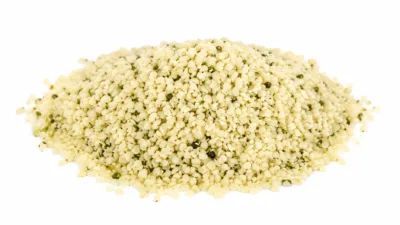
Organic Hemp Hearts
Available in < 5%, 5–10%, 10–15%, 15–20% Green Skin and customized. All specifications support…
Related Posts