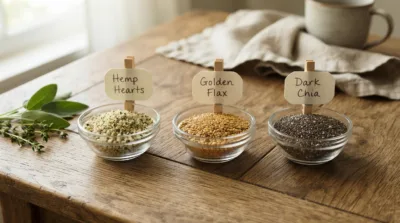
Hemp seeds vs hemp hearts is a question we get from every new buyer. A hemp seed with its green hull still on is a complete raw seed; a hemp heart is the same kernel with the hull removed, which…
Organic hemp seed hearts versus common nuts is less a marketing contest than a spec-sheet comparison. Three numbers decide it: protein per gram, omega-3 content and allergen status.
On all three counts, hemp hearts make the nuts work hard for the win. They deliver about 9.5 g of protein per 30 g serving, more than almonds, walnuts or peanuts, plus roughly 2.6 g of plant omega-3 that almonds and peanuts effectively do not provide at all. And they sit outside the major allergen lists, which quietly changes the labelling maths for snack and bakery manufacturers.
Walnuts are the only serious omega-3 rival here. Everything else you need is below: a per-30-gram macro table, allergen and shelf-life notes, and answers on cost and substitution.
What are organic hemp seed hearts?
Hemp hearts go by a few names on ingredient labels: hulled hemp seeds, or shelled hemp seed. They are the soft inner kernels of *Cannabis sativa* L. seed, left once the fibrous shell has been mechanically removed. No solvents involved and no cannabinoid extraction, just dehulling.
That dehulling step is what makes the spec competitive. It strips away most of the insoluble fibre and concentrates protein and lipid instead, leaving a kernel that runs around 31-32% protein and 48-49% fat.
The protein fraction consists of edestin and albumin, both easy to digest. On the lipid side, the omega-6 to omega-3 ratio sits near 3:1, which is unusual among edible seeds and nuts.
Texture deserves its own mention. Hemp hearts are soft and creamy, closer to a pine nut than an almond, and that single trait drives most formulation decisions.
Spec table: hemp hearts vs almonds, walnuts, peanuts
All figures per 30 g serving, rounded.
| Attribute | Value (Hemp Hearts / Almonds / Walnuts / Peanuts) | B2B Note |
|---|---|---|
| Protein | 9.5 g / 6.3 g / 4.6 g / 7.7 g | Protein claim at the smallest serving size |
| Total fat | 14.6 g / 15.0 g / 19.6 g / 14.8 g | Comparable load; walnuts highest |
| Omega-3 (ALA) | 2.6 g / trace / 2.7 g / trace | Only hemp and walnuts are real ALA sources |
| Omega-6 (LA) | 8.2 g / 3.7 g / 11.4 g / 4.7 g | Hemp’s ~3:1 ratio is the cleanest here |
| Dietary fibre | 1.2 g / 3.8 g / 2.0 g / 2.6 g | Dehulling removes fibre; pair with oats |
| Magnesium | 210 mg / 81 mg / 47 mg / 50 mg | Strongest fortification case in the group |
| Allergen status | Not listed / Tree nut / Tree nut / Peanut | Hemp avoids US Big 9 and EU 14 declarations |
| Shelf life | ~12 months unopened, refrigerate after opening / 12 / shorter, high PUFA / 12 | Nitrogen-flush hemp hearts |
| Δ9-THC | <0.3% dry weight limit, kernels usually non-detect / n/a / n/a / n/a | COA required per hemp lot |
*Source: USDA FoodData Central, per 30 g, rounded. Shelf life varies by batch, packaging and storage.*
How to use hemp hearts in place of nuts
Bars and clusters: substitute at 5-15%. Hemp hearts lack crunch, so hold on to 30-50% of the nut inclusion purely for texture.
Bakery: fold in or top at 2-5%. Hemp hearts brown faster than almonds, so ease off the top heat or add them late in the process.
Dairy alternatives: wet-mill at 5-10% for a nut-free milk base. Cold-process below 40°C to protect the ALA fraction.
Dry mixes: straight 1:1 substitution by weight works in granola, yoghurt toppers and salad blends.
However you use them, store the kernels sealed in nitrogen-flushed packaging and refrigerate opened bulk stock. Rancidity, not microbial spoilage, is what ends their shelf life.
Benefits that change the spec sheet
Protein is the headline number. At 9.5 g per 30 g serving, hemp hearts contribute to a protein claim at lower inclusion than any of the three nuts can manage.
That 3:1 ratio explains why formulators keep reaching for them. Linoleic and alpha-linolenic acids contribute to the maintenance of normal blood cholesterol levels as part of a balanced diet. Almonds and peanuts supply almost no ALA by comparison.
Magnesium builds the case further: 210 mg per serving, roughly two and a half times what almonds offer. That is enough to fortify a product without reaching for a synthetic premix.
The decisive differentiator, though, is allergen status. Hemp hearts sit outside the US Big 9 and EU 14 major-allergen lists, so a manufacturer can build a nut-free premium snack or bakery line that almonds and peanuts simply cannot support. A nut-free product that still reads premium also opens school, airline and childcare channels that stay closed to almond and peanut formats.
Safety, allergens and shelf life
Hemp does not appear on the US Big 9 or EU 14 allergen lists, and hemp seed allergy is rare. One caveat applies: wherever hemp hearts run on shared lines with tree nuts or sesame, cross-contact still has to be declared. Audit your co-packer before putting nut-free claims anywhere near the artwork.
Every lot should come with a Δ9-THC result. Kernels normally test non-detect because cannabinoids sit in the shell and bract material, which is precisely why shell contamination is the failure point worth watching.
Oxidation is the main quality risk, a consequence of the high polyunsaturated content. Specify peroxide value on incoming COAs, avoid clear packaging and run FIFO on bulk stock.
FAQ
Are hemp hearts more expensive than almonds?
Landed cost moves with crop year, origin and organic status, so request a current quote. Worth noting: because hemp hearts hit protein targets at lower inclusion, cost per gram of protein often compares better than price per kilogram suggests.
Can I substitute hemp hearts for nuts one-for-one?
By weight, yes, in dry mixes and toppings. In bars and cookies, keep part of the nut inclusion for crunch. Hemp hearts are soft and will never replicate almond bite.
Can I label a hemp hearts product nut-free?
Hemp is botanically a seed, so the ingredient itself qualifies. Whether the claim holds depends entirely on your facility’s documented cross-contact controls.
Request the hemp hearts spec sheet
The texture swap is usually the only surprise. Tell us your almond or peanut inclusion rate and we will size the sample to match it. If a nut replacement is on your roadmap, ask us for the spec sheet: proximate analysis, fatty acid profile, magnesium, kernel grade, peroxide value, heavy metals and Δ9-THC results. Every request ships with a 1 kg sample so you can benchmark texture and browning against your current almond or peanut line.
Related Posts