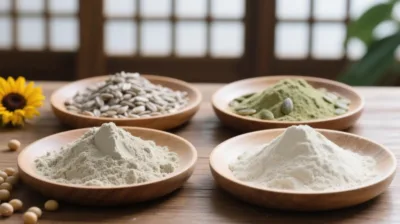
The question of how food choices affect the planet has moved from niche conversations to mainstream concern. Among plant-based proteins, sunflower seeds are drawing attention not just for their nutritional profile but for their environmental credentials. Sunflower protein sustainability is more than a marketing phrase. It reflects measurable advantages in water consumption, land use, and carbon output compared to many commonly consumed protein sources.
For businesses formulating clean-label products and consumers trying to shrink their dietary footprint, knowing what makes sunflower protein a lower-impact choice matters. HEMPLAND offers organic sunflower seed protein sourced from crops grown with sustainability as a core priority.
The environmental cost of conventional protein sources
The environmental footprint of animal-based protein is well documented. According to a 2018 study published in *Science*, beef production requires roughly 20 times more land and generates 20 times more greenhouse gas emissions per gram of protein than plant sources such as peas and beans. Dairy carries a heavy burden of its own: the FAO estimates that global livestock supply chains account for 14.5% of all human-induced greenhouse gas emissions.
Plant proteins are not automatically low-impact, either. Almond farming in California consumes roughly 3.2 gallons of water per single almond, according to the California Department of Water Resources. Soy production has been linked to deforestation in the Amazon and Cerrado regions, where an estimated 8.2 million hectares were converted for soy cultivation between 2001 and 2016, per research published in *Nature Sustainability*.
These figures put a premium on protein sources that perform well across several environmental metrics: water, land, carbon, and biodiversity. Sunflower-based protein belongs in that conversation as an underrated option.
Why sunflower seeds stand out as a low-impact crop
Sunflowers (*Helianthus annuus*) are native to North America and have been cultivated for thousands of years. Their modern commercial value spans oil production, confectionery seeds, and, more recently, protein ingredients. Several agronomic traits make the crop a natural fit for sustainable farming systems.
A sunflower sends a deep taproot 1.5 to 2.7 meters into the soil. That root structure pulls water and nutrients from deeper layers, which cuts the need for irrigation and synthetic fertilizer. The taproot also breaks up compacted soil, leaving better structure for whatever crop follows in rotation.
Sunflowers tolerate a wide range of climates, too. They grow successfully across Europe, North and South America, and parts of Asia and Africa. That geographic flexibility often allows regional sourcing, which shortens supply chains and trims transport-related emissions.
Water usage: sunflower vs. other plant proteins
Water scarcity affects every major agricultural region on the planet. The United Nations projects that by 2025, 1.8 billion people will live in areas of absolute water scarcity. Protein crops with modest irrigation demands offer one practical response.
Sunflowers are classified as drought tolerant. Research from the USDA Agricultural Research Service indicates they can produce viable yields on as little as 200-300 mm of seasonal rainfall, depending on soil type and variety. Soy typically needs 450-700 mm, and almonds demand over 1,000 mm per growing season in California production systems.
A 2019 water footprint assessment published in *Ecological Indicators* placed sunflower seeds among the lower-impact oilseed crops, with a global average water footprint of roughly 3,400 liters per kilogram of seeds. Milling those seeds into protein powder stretches the water investment further: once the oil fraction is separated for other uses, the concentrated protein becomes one of two product streams paid for by a single water input.
That efficiency has practical weight. Brands working toward corporate water stewardship targets, and consumers in water-stressed regions, gain a protein option aligned with conservation priorities.
Carbon footprint: how sunflower protein compares
Agriculture accounts for roughly 11% of total global emissions according to the IPCC, and protein production, particularly from ruminant animals, claims a disproportionate share of it.
Life cycle data specific to sunflower protein is still developing, but the available research offers useful reference points. A 2020 study in the *Journal of Cleaner Production* analyzed the carbon footprint of various oilseed crops in European production systems. Sunflower cultivation came in at roughly 0.4-0.8 kg CO2 equivalent per kilogram of seeds, compared to roughly 0.6-1.2 kg for soy and far below the 25-60 kg CO2-eq per kilogram range for beef protein.
Processing holds up under scrutiny, too. Converting sunflower seeds into protein powder through mechanical pressing and milling demands less energy than methods used for some other plant proteins. HEMPLAND’s sunflower protein is cold-pressed without hexane or other chemical solvents, which lowers both the chemical load and the energy bill of production.
Land use efficiency and biodiversity benefits
Land use change is the primary driver of biodiversity loss worldwide. The IPBES Global Assessment Report on Biodiversity and Ecosystem Services identified agricultural expansion as the single biggest factor in species decline. Protein choices that need less land per gram of usable protein attack that pressure at its source.
Sunflower crops generate several value streams from the same plot: seeds for oil extraction, protein-rich meal after pressing, and biomass that can return to the soil or serve as animal bedding. Spreading outputs this way improves land use efficiency compared to crops grown for a single purpose.
Sunflower fields also deliver ecological services that monoculture grain crops rarely match. The blooms are rich nectar sources for pollinators, and research from the University of California Cooperative Extension has documented higher bee diversity and abundance along sunflower field margins than in adjacent fields without flowering plants. That support matters more every year as managed and wild bee populations face habitat loss and pesticide exposure.
Sunflower’s role in regenerative agriculture
Regenerative agriculture favors practices that rebuild soil organic matter, improve water cycles, and strengthen ecosystem function rather than merely limiting damage. Sunflowers slot into these systems with little friction.
That deep root system stores carbon below the surface, feeding long-term soil carbon storage. Sunflowers are also effective scavengers of residual nitrogen left by previous crops, which reduces nitrate leaching into groundwater. A 2017 study in *Agriculture, Ecosystems & Environment* found that sunflower as a rotational crop cut nitrate levels in soil water by 25-40% compared to continuous cereal cropping across the European sites studied.
Under organic production, the standard HEMPLAND applies to its sunflower sourcing, these advantages grow. With no synthetic inputs, the crop’s natural pest resistance and nutrient scavenging become more valuable still. Organic cultivation also sustains soil microbial communities that long-term comparisons, including the Rodale Institute’s Farming Systems Trial, have shown to be depleted under conventional management.
Sustainable processing: from seed to protein powder
An ingredient’s environmental story includes processing, not just farming. Two routes dominate protein powder production from oilseeds: solvent extraction and mechanical pressing.
Solvent extraction, typically with hexane, strips more oil and therefore raises protein concentration in the remaining meal. The catch: hexane is classified as a hazardous air pollutant by the U.S. EPA, and solvent recovery systems add energy inputs that inflate the product’s carbon footprint.
Mechanical cold-pressing skips chemical solvents entirely. Residual oil runs slightly higher in the finished powder, yet the process preserves heat-sensitive compounds, leaves no solvent residues, and uses less energy overall. Plenty of clean-label brands accept that trade-off knowingly in exchange for solvent-free ingredients.
The pressed-out sunflower oil is itself a saleable commodity for food manufacturing, cosmetics, and, increasingly, biodiesel. Splitting cultivation costs across two products improves the overall sustainability math for the crop.
HEMPLAND’s commitment to eco-friendly packaging
Sustainability has to extend to packaging. Protein powders have traditionally shipped in multi-layer plastic pouches with limited recyclability. The flexible packaging industry is beginning to move, pushed by consumer pressure and regulatory changes in markets such as the European Union, where the Packaging and Packaging Waste Directive sets ever stricter recyclability requirements.
HEMPLAND’s organic sunflower seed protein is packaged with attention to material reduction and recyclability. Packaging partners are evaluated on post-consumer recycled content and participation in recovery schemes. Fully compostable pouches for protein powders remain technically difficult because of moisture barrier requirements, but the direction of travel is clearly toward circularity.
Quantity helps as well. Buyers purchasing the 5 kg and bulk formats HEMPLAND offers shrink the packaging-to-product ratio, since larger formats generate less waste per serving than single-serving sachets or small retail pouches.
Consumer choices that make a difference
Individual purchasing decisions, multiplied across millions of shoppers, genuinely move supply chains. Plant-based milk already proves the dynamic: alternatives now hold roughly 15% of the U.S. milk market according to the Plant Based Foods Association, and that share has redirected investment across dairy and non-dairy production alike.
Choosing sunflower protein over higher-impact alternatives is one lever. Buying in bulk cuts packaging waste. Transparent supply chain documentation rewards accountable producers. Third-party certifications such as organic, non-GMO, and fair trade separate verified practice from marketing copy.
Anyone juggling food sensitivities alongside sustainability concerns gets a bonus: sunflower protein is free from the top allergens that trigger reactions in sensitive individuals. The article on the soy-free solution for sensitive formulations explores that dimension in greater detail.
How to incorporate sustainable proteins into daily life
The practical question is how to make sunflower protein a routine part of meals without disruption. The powder has a mild, slightly nutty flavor that settles easily into many foods.
Common applications include blending into smoothies with fruit and leafy greens, stirring into oatmeal or yogurt, and substituting part of the flour in baking recipes. On the savory side, it slips into soups, sauces, and homemade veggie burger mixes without shifting the flavor profile much.
Formulators should note that sunflower protein behaves differently than whey or soy, and those differences shape results. The detailed guide on organic sunflower seed protein nutrition and applications covers specifications, solubility, and usage rates.
Market signals point the same way. Research on consumer trends and market demand for organic pumpkin seed protein shows sustainability ranks among the top three purchase drivers for plant protein buyers, alongside health and taste.
Where sunflower protein fits in a lower-impact diet
Sunflower protein’s sustainability case rests on verifiable specifics: a drought-tolerant crop with roots reaching meters deep, irrigation needs far below almonds or soy, carbon figures that beat both beef and several plant alternatives, and a solvent-free path from seed to powder.
Consumers get a practical step toward a lighter dietary footprint without surrendering protein quality or kitchen flexibility. Brands and formulators get a sustainability narrative backed by agronomic data, supply chain transparency, and packaging that keeps improving.
HEMPLAND continues to source in ways that support soil health, limit water consumption, and preserve traceability from field to finished product. Questions about sourcing, specifications, or bulk orders go straight to the HEMPLAND team through the Contact Us page.
Recommended Products
Organic Pumpkin Seed Protein Powder
Organic pumpkin seed protein powder offers ≥60% protein with high magnesium, zinc, and iron…
Related Posts