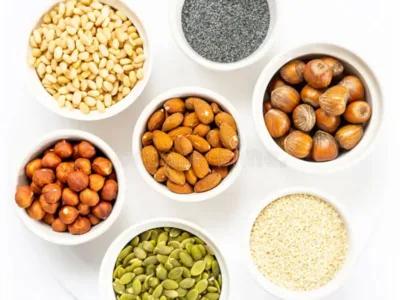
Super seeds have taken the nutrition world by storm. Walk through any health food store and you will find bins of tiny powerhouses promising protein, omega fatty acids, fiber, and minerals in concentrated form. Three stand out above the rest: hemp hearts, flax seeds, and chia seeds. Each has its own nutritional advantages and has earned a place in the conversation around functional whole foods. Picking between them, or deciding which ones deserve pantry space, gets confusing once the marketing blurs the real differences.
We break the three down across protein quality, omega ratios, fiber, taste, shelf life, and what they are actually good for in the kitchen, so you can match a seed to your own goals.
Nutritional profile comparison
The quickest way to see how these three seeds differ is side by side. The table below compares a standard 30-gram serving, roughly three tablespoons of hemp hearts, two tablespoons of chia seeds, or three tablespoons of ground flax seeds.
| Nutrient (per 30g) | Hemp Hearts | Flax Seeds (ground) | Chia Seeds |
|---|---|---|---|
| Calories | 170 kcal | 160 kcal | 146 kcal |
| Protein | 10 g | 6 g | 5 g |
| Total Fat | 14 g | 12.7 g | 9.2 g |
| Omega-3 (ALA) | ~3 g | ~6 g | ~5 g |
| Omega-6 (LA) | ~9 g | ~1.5 g | ~1.4 g |
| Carbohydrates | 4.4 g | 8.6 g | 12.6 g |
| Fiber | ~1 g | ~8 g | ~10 g |
| Net Carbs | ~1.4 g | ~0.5 g | ~2.3 g |
| Magnesium | 210 mg (50% DV) | 100 mg (25% DV) | 95 mg (23% DV) |
| Iron | 2.4 mg (13% DV) | 1.6 mg (9% DV) | 1.6 mg (9% DV) |
| Zinc | 3.0 mg (27% DV) | 1.1 mg (10% DV) | 1.0 mg (9% DV) |
| Calcium | 21 mg (2% DV) | 69 mg (7% DV) | 179 mg (14% DV) |
| Thiamin (B1) | 0.4 mg (33% DV) | 0.5 mg (42% DV) | 0.1 mg (8% DV) |
The numbers tell a clear story. Hemp hearts lead decisively on protein and minerals, especially magnesium, iron, and zinc. Flax seeds dominate in ALA omega-3 and thiamin, plus they are uniquely rich in lignans, polyphenolic compounds with antioxidant properties. Chia seeds are the fiber and calcium champions, with ten times the fiber of hemp hearts and the highest calcium of the three.
For anyone chasing daily protein targets, organic hemp hearts deliver the most protein per serving of any common seed, which makes them a reliable staple for both plant-based and omnivorous diets.
Omega fatty acid ratios
Omega content is one of the main reasons people reach for these seeds, but the raw amount of omega-3 is only half the story. The omega-6 to omega-3 ratio matters just as much, because both fatty acids compete for the same enzymatic pathways. Too much omega-6 relative to omega-3 pushes inflammatory signaling, while a balanced ratio supports healthier metabolic outcomes.
Hemp hearts: the balanced ratio
Hemp hearts deliver roughly 3 grams of ALA omega-3 per 30-gram serving alongside about 9 grams of omega-6, for an omega-6-to-omega-3 ratio of about 3:1. That ratio sits close to ideal for human dietary needs. Nutrition researchers have suggested that a ratio between 2:1 and 4:1 supports balanced inflammatory signaling, while the typical Western diet, heavy on processed vegetable oils, often exceeds 15:1. Hemp hearts pull the ratio back toward balance without asking you to change anything else on your plate.
Flax seeds: high aLA, low omega-6
Flax seeds give about 6 grams of ALA per serving, the highest of any common seed, but their omega-6 sits around 1.5 grams. That produces a ratio below 0.3:1, so omega-3 vastly outweighs omega-6. Sounds great on paper, except that extremely low omega-6 intake creates its own imbalances. Omega-6 fatty acids are not inherently harmful. Linoleic acid is essential for skin barrier function, cell membrane integrity, and immune signaling. The problem is excess, not presence.
Chia seeds: similar profile to flax
Chia seeds follow a pattern close to flax, roughly 5 grams of ALA and 1.4 grams of omega-6, for a ratio around 0.3:1. The high ALA helps anyone trying to raise omega-3 intake, particularly people who do not eat fatty fish regularly. But like flax, the near-absence of omega-6 means chia alone does not fix the balance question.
Why the ratio matters
The body converts ALA to the longer-chain EPA and DHA at a low rate, estimated at 5 to 10 percent for EPA and under 5 percent for DHA. That conversion depends on the enzyme delta-6 desaturase, which both omega-3 and omega-6 compete for. When omega-6 far outpaces omega-3, as it does in most Western diets, ALA-to-EPA/DHA conversion gets even less efficient. Hemp hearts, at 3:1, ease that competition and support more effective conversion. Flax and chia supply abundant ALA substrate but, without proportional omega-6, they leave the enzymatic bottleneck in place.
For practical guidance on fitting hemp hearts into daily nutrition, our article on how much hemp hearts per day covers serving sizes, macro targets, and scheduling by health goal.
Protein quality
Protein is where hemp hearts separate themselves most clearly from flax and chia. Ten grams per serving, double chia and nearly double flax, is a meaningful gap for anyone tracking daily intake.
Complete vs. incomplete protein
Hemp hearts contain all nine essential amino acids in adequate proportions, which makes them a rare complete protein from a plant food. Edestin and albumin, the two primary storage proteins in hemp seeds, give a well-distributed amino acid profile including lysine, the one many grain-based proteins lack.
Flax and chia are both incomplete proteins. Flax is limited in lysine, and chia, while it contains all nine amino acids, falls short on several, particularly lysine, against the FAO/WHO scoring pattern. The practical consequence: if you lean on flax or chia as a primary protein source, you need complementary foods, legumes, grains, or other lysine-rich sources, to close the gaps.
Digestibility and bioavailability
Protein digestibility matters alongside quantity. Hemp hearts digest better than flax or chia, partly because hulling removes the fibrous outer shell that would otherwise encase the protein matrix. The soft, exposed interior lets digestive enzymes reach the amino acids directly.
Flax is the harder case. Its protein is locked inside a hard seed coat that resists mechanical breakdown in the stomach. Grinding helps, but even ground flax does not match hulled hemp hearts for digestibility. Chia is easier to digest whole than flax, though its gel-forming fiber matrix can slow amino acid absorption.
For low-carb dieters wondering about protein sources, our guide on are hemp hearts keto explains how hemp hearts fit ketogenic macro budgets while still delivering complete protein.
Fiber content and gut health
Fiber is where chia and flax pull well ahead of hemp hearts. Understanding why, and what it means for your digestion, clarifies which seed fits your priorities.
Chia seeds: the fiber leader
Chia seeds give about 10 grams of fiber per 30-gram serving, roughly 35 percent of the recommended daily intake. The fiber is a mix of soluble and insoluble, with the soluble fraction driving chia’s signature gel. When chia sits in liquid, that soluble fiber absorbs water and swells into a thick mucilage that slows gastric emptying and supports steady glucose absorption. The gel also feeds beneficial gut bacteria, contributing to short-chain fatty acid production in the colon.
Flax seeds: soluble fiber and lignans
Flax seeds deliver about 8 grams of fiber per serving, mostly soluble. Soluble fibre forms a gel in water like chia, though less dramatically. Flax also carries lignans, polyphenolic compounds with antioxidant and mild estrogen-modulating properties, at concentrations roughly 75 to 800 times higher than any other common food. Lignans are not fiber themselves, but they travel with the fiber matrix and release during digestion, contributing to gut health through antioxidant activity and microbiome interactions.
Hemp hearts: low fiber, and why
Hemp hearts hold only about 1 gram of fiber per serving. That is not a deficiency, it is a direct result of the hulling process. Hemp hearts are shelled hemp seeds, and the fibrous outer hull, which would add 7 to 8 grams of fiber per serving, is removed to expose the soft, nutrient-dense interior. The trade-off is deliberate: dropping the shell makes hemp hearts more palatable, more digestible, and more versatile in cooking, at the cost of fiber.
Whole hemp seeds, shell intact, are far higher in fiber, comparable to flax. Most buyers prefer hulled hemp hearts for texture and convenience. If fiber is the priority, pairing hemp hearts with chia or flax in a daily seed mix covers both bases.
Taste, texture, and culinary uses
Nutrition data matters, but the food you actually enjoy eating is the food you will keep eating. Taste, texture, and ease of use vary a lot among these three, and each suits different kitchen jobs.
Hemp hearts: mild and versatile
Hemp hearts have a mild, slightly nutty flavor with a soft, almost creamy texture. No grinding, soaking, or prep required, you can eat them straight from the bag. That convenience makes hemp hearts the most versatile of the three. They blend into smoothies without changing texture, sprinkle over salads and grain bowls for a protein boost, mix into yogurt and oatmeal, and fold into baking from muffins to energy bars. Their neutral flavor enhances rather than competes with other ingredients.
Flax seeds: earthy and ground-Dependent
Flax seeds have an earthy, slightly nutty flavor that pairs well with baked goods, smoothies, and warm cereals. The catch: flax must be ground before eating to reach its nutrients. Whole flax passes through the digestive tract largely intact, so the omega-3, protein, and lignans inside stay unabsorbed. Ground flax, sometimes sold as flax meal, works into pancake batter, bread dough, and smoothies, but its slightly gritty texture and stronger flavor limit its versatility next to hemp hearts.
Flax also works as an egg substitute in vegan baking. One tablespoon of ground flax mixed with three tablespoons of water, left to sit five minutes, makes a gel that mimics egg’s binding in muffins, cookies, and quick breads.
Chia seeds: neutral and gel-Forming
Chia seeds have a very mild, almost neutral flavor. Their distinguishing trait is texture: soaked in liquid, chia absorbs water and forms a thick gel, expanding to roughly ten times its dry volume. That gel makes chia ideal for puddings, jams, and overnight oats where a thick, satisfying consistency is wanted. Chia also serves as an egg substitute in baking, one tablespoon of chia seeds (or two tablespoons of chia gel) replaces one egg.
In smoothies, chia acts as a thickener. A tablespoon in a blender drink builds a richer, more substantial texture within minutes. The downside: if you want a thin, drinkable smoothie, chia’s thickening may be unwanted. Hemp hearts, by contrast, add nutrition without shifting consistency, an advantage for smoothie drinkers who want protein and omegas with no texture change.
For a deeper look at culinary uses, nutrient absorption, and cost between hemp hearts and chia specifically, our hemp hearts vs chia seeds article covers the two-seed matchup.
Digestibility and absorption
How easily your body pulls nutrients from a seed depends on its physical structure. This is exactly where hemp hearts, flax, and chia diverge in ways that shape nutritional outcomes.
Hemp hearts: ready to absorb
Because hemp hearts are hulled, their protein, fat, and minerals are immediately accessible to digestive enzymes. No grinding, soaking, or chewing required. The soft interior digests readily, and studies on hemp protein digestibility consistently report favorable absorption rates. For anyone who values convenience and guaranteed nutrient delivery, hemp hearts are the most reliable choice.
Flax seeds: grinding is mandatory
Whole flax seeds are effectively indigestible. Their hard outer coat resists mechanical breakdown in the stomach and small intestine, so the nutrients inside, omega-3, protein, lignans, pass through unabsorbed. Grinding flax before eating is essential, and even ground flax has limits: the fine particles oxidize quickly once the seed coat breaks, and the texture may not suit every dish. Pre-ground flax meal is convenient but has a shorter shelf life from the extra surface area exposed to air.
Chia seeds: digestible whole
Chia seeds are a middle ground. Their softer outer layer lets digestive enzymes penetrate without grinding, though some nutritionists recommend soaking or lightly crushing chia to optimize absorption. The gel chia forms in the digestive tract slows the rate nutrients enter the bloodstream, a benefit for blood sugar regulation since it reduces post-meal glucose spikes. That slower absorption also extends satiety, helping you stay full longer after eating.
Storage and shelf life
Practical details like shelf life and storage affect which seed you reach for regularly. Easy storage means easy use.
Hemp hearts
Hemp hearts stay fresh for 6 to 12 months refrigerated in a sealed container. Their relatively high fat content makes them prone to oxidation at room temperature over time, though short pantry stints (a few weeks) are fine. HEMPLAND packages its organic hemp hearts in resealable bags built to minimize air exposure, and refrigerating after opening extends freshness to the full 12-month window.
Flax seeds
Flax is the most awkward to store. Whole flax seeds last up to a year at room temperature or longer refrigerated, because the intact seed coat protects the oil from oxidation. But once ground, which is required for nutrient absorption, flax meal goes rancid fast, often within 2 to 3 months even refrigerated. The practical fix: buy whole flax and grind small batches in a coffee grinder or spice mill just before use. It adds a step but guarantees freshness and nutrient retention.
Chia seeds
Chia seeds are the storage champions. Their dense outer layer and natural antioxidants protect the oil from oxidation, so chia lasts 2 or more years at room temperature with no real quality loss. No refrigeration, no grinding, no special containers beyond a sealed bag or jar. For buyers who value long shelf life and minimal prep, chia is the most hassle-free option.
Which seed is best for your goals?
The honest way to choose is by goal.
Best for protein: hemp hearts
At 10 grams of complete protein per serving, hemp hearts beat flax and chia by a wide margin. The completeness of that protein, all nine essential amino acids, makes hemp hearts the only seed that can meaningfully move daily protein targets on its own, with no complementary foods needed to fill amino acid gaps.
Best for omega-3 (ALA): flax or chia
If your primary objective is maximizing ALA omega-3, flax seeds (6 grams per serving) and chia seeds (5 grams) deliver more total ALA than hemp hearts (3 grams). Hemp hearts, though, offer a more balanced omega-6-to-omega-3 ratio, which supports more efficient conversion of ALA to longer-chain EPA and DHA. The choice depends on whether you want absolute ALA quantity or balanced fatty acid intake.
Best for fiber: chia seeds
Chia’s 10 grams of fiber per serving, a mix of soluble and insoluble, supports gut health, satiety, and steady blood sugar. Flax is close behind at 8 grams, mostly soluble. Hemp hearts, at 1 gram, are not a fiber source unless you choose whole hemp seeds with the shell on.
Best for overall nutritional balance: hemp hearts
No single category defines overall value. Hemp hearts bring complete protein, an ideal omega ratio, real mineral content (magnesium, iron, zinc), and easy digestibility. They lack fiber, but their balanced profile across protein, fat quality, and micronutrients makes them the most well-rounded seed for daily use.
Best for baking: flax or chia
Both flax and chia work as egg substitutes and binders in vegan and allergen-free baking. Flax meal gives a slightly earthy flavor and a modest binding gel. Chia gives a clearer gel with a more neutral taste. Choose flax for hearty baked goods like muffins and breads, chia for lighter applications like puddings and jams.
Best for smoothies: hemp hearts or chia
Hemp hearts add protein and omegas without changing texture, ideal for drinkers who want a smooth, drinkable result. Chia thickens smoothies into a richer, more substantial drink, which some prefer for satiety. Both work; it comes down to texture preference.
Can you combine all three?
Absolutely. Each seed covers the others’ weaknesses, and a daily seed mix is a smart strategy that costs almost no effort.
Hemp hearts provide complete protein and the balanced omega ratio your body needs for efficient fatty acid metabolism. Flax seeds add concentrated ALA and lignans, antioxidant compounds absent in meaningful amounts from either hemp or chia. Chia seeds round out the mix with high fiber for gut health, calcium for bone support, and a gel-forming texture that extends satiety.
A simple approach: combine one tablespoon of each seed in your morning smoothie, yogurt bowl, or oatmeal. That gives roughly 7 grams of protein, 14 grams of combined ALA, 6 grams of fiber, and a balanced spread of minerals, all from three tablespoons of whole-food ingredients. Adjust the proportions to your priorities: more hemp hearts if protein matters most, more chia if fiber is the goal, more flax if omega-3 ALA is your focus.
The mix also solves the storage and prep problems that complicate single-seed use. Hemp hearts need refrigeration but no grinding. Flax needs grinding but lasts indefinitely whole. Chia needs neither. By rotating all three, you work around each seed’s practical limits while capturing every nutritional advantage.
If I had to keep just one in the pantry, it would be hemp hearts. They are the only one of the three that pulls its weight on protein, and the 3:1 omega ratio is the one thing flax and chia cannot give you. But the real answer for most people is the trio: chia for fiber, flax for ALA density, hemp for complete protein and balance.
Conclusion
No single seed is “best”, they each shine in different lanes. Hemp hearts offer the most balanced overall nutrition with complete protein, an ideal omega-6-to-omega-3 ratio, and the strongest mineral content (210 mg magnesium, 2.4 mg iron, 3.0 mg zinc per 30 g). Flax seeds dominate in ALA omega-3 (6 g) and lignans (75 to 800 times more than any common food), a strong pick for anti-inflammatory and antioxidant support. Chia seeds are the fiber and calcium champions (10 g fiber, 179 mg calcium per 30 g), with unmatched shelf life and a gel-forming property that aids gut health and satiety.
The practical read: if protein and balanced omegas lead your priorities, hemp hearts from HEMPLAND belong at the top of the pantry. If fiber, calcium, or maximum ALA drives your choices, add chia and flax alongside them. For the broadest coverage, combine all three in a daily seed mix, each seed fills the gaps the others leave open.
Frequently asked questions
Q: Which has more complete protein, hemp hearts, flax, or chia? A: Hemp hearts are a complete protein with all nine essential amino acids; flax and chia are protein-light and valued mainly for ALA omega-3 and fiber, not protein quality.
Q: Do hemp hearts, flax, and chia all provide omega-3? A: All three supply ALA plant omega-3, but hemp hearts also add a balanced ~3:1 omega-6 to omega-3 ratio plus GLA, whereas flax and chia are ALA-dominant.
Q: Which is best for baking and granola? A: Hemp hearts need no grinding and keep a mild nutty taste, making them ideal for granola, bars, and toppings; flax and chia are often milled for binding or egg replacement.
Related Posts