For most adults, organic hemp seed oil side effects and interactions are mild and dose-related. Most cases involve loose stools at high single doses, plus a theoretical additive effect with anticoagulant therapy from the oil’s omega-3 load. That is the short answer compliance teams usually need.
The longer answer matters whenever a formula targets medicated, pregnant, or elderly consumers. Label language and COA documentation carry real liability there. What follows covers what hemp seed oil actually is, a caution table by population group, dosing guidance, oxidation risk, and the pregnancy and blood-thinning questions buyers ask most.
What is organic hemp seed oil?
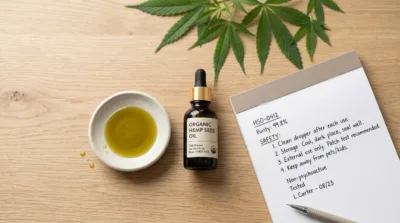
Organic hemp seed oil is cold-pressed from the seeds of *Cannabis sativa* L. It is a culinary and cosmetic lipid, not a cannabinoid extract. CBD oil comes from flower and leaf material; hemp seed oil does not, and the two should never share label copy.
In short: a cold-pressed culinary and cosmetic oil valued for its roughly 3:1 omega-6 to omega-3 fatty acid ratio, used across foods, supplements, and topicals, containing no CBD or other cannabinoids.
The defining spec is the fatty acid profile: linoleic acid at roughly 50-60% and alpha-linolenic acid at roughly 15-25%, which puts the omega-6 to omega-3 ratio near 3:1. Gamma-linolenic acid sits at low single-digit percentages depending on cultivar.
That polyunsaturated load is both the selling point and the handling problem. The oil oxidises readily and has a smoke point near 165°C.
Spec table: caution profile and key limits
Use this as the starting point for a formulation risk assessment, not as medical guidance.
| Attribute | Value | B2B Note |
|---|---|---|
| Source and process | Cold-pressed *Cannabis sativa* L. seed | Not CBD oil, separate the label copy |
| Δ9-THC | <0.3% dry weight limit; seed oil usually non-detect | EFSA acute reference dose 1 µg/kg body weight; require a COA |
| Omega-6 : omega-3 | ~3:1 (LA 50-60%, ALA 15-25%) | High PUFA load; oxidation is the main risk |
| Anticoagulant users | High omega-3 intake may prolong bleeding time | Add a physician-consultation line on high-dose SKUs |
| Pregnancy, lactation | Lipids are food-grade; trace THC is the open question | Avoid dosing claims; specify non-detect THC |
| Antihypertensive therapy | Omega-3 oils may mildly add to blood-pressure lowering | Flag for medical-nutrition SKUs |
| GI tolerance | Loose stools reported above roughly 30 mL per dose | Split dosing or move to softgels |
| Allergen status | Not a listed major allergen; hemp seed allergy rare | Declare shared-line nut or sesame contact |
| Shelf life | ~12 months unopened; 1-3 months refrigerated after opening | Amber packaging, nitrogen flush, specify peroxide value |
*Source: USDA FoodData Central (fatty acid composition); EFSA statement on acute human exposure to Δ9-THC, 2015. Shelf life and peroxide values vary by batch.*
How to use and dose it safely
Food takes cold applications only: dressings, dips, finishing oils, cold-blended drinks. Add below 40°C where possible and never fry with it. Dressing bases take 10-30%.
Supplements commonly run 5-15 mL per day, split across meals. Softgels at 500-1,000 mg control dose and limit air exposure. Above roughly 30 mL in one sitting, GI complaints rise sharply.
Cosmetics use 1-10% in emulsions, higher in facial oils and balms. Pair with tocopherol and validate accelerated stability before locking a claim.
Store drums cold, dark, and full. Headspace oxygen, not microbiology, causes most rejected lots.
Benefits behind the precautions
The 3:1 omega ratio is why the oil gets specified at all. Linoleic and alpha-linolenic acids are essential fatty acids; they underpin the maintenance of normal blood cholesterol levels when consumed as part of the overall diet.
Gamma-linolenic acid supports barrier-repair and soothing positioning in topical formats.
For procurement, the oil is plant-based, available certified-organic, and outside the major allergen lists, which shortens export allergen matrices. As a side stream alongside hemp protein, it also backs low-waste sourcing claims.
Safety and precautions summary
In practice the risk picture is narrow: dose-related GI upset, oxidation-driven off-flavour, a theoretical interaction with anticoagulant and antihypertensive medication, and trace-THC exposure.
Verify Δ9-THC on every lot even though seed oil should test non-detect; flower cross-contact at harvest is the contamination route.
Carry a consult-a-physician statement for pregnant, nursing, and medicated consumers, and make no therapeutic claims.
FAQ
Q: Does hemp seed oil thin the blood? A: It is not an anticoagulant, but its omega-3 content can theoretically add to the effect of warfarin, DOACs, or aspirin at high intakes. Hemp-specific clinical data is limited, so a physician-consultation statement is the appropriate label control.
Q: Is organic hemp seed oil safe during pregnancy? A: The fatty acids are food-grade. The open question is residual Δ9-THC, which is why non-detect COA documentation matters and why dosing claims aimed at pregnant consumers should be avoided.
Q: Can hemp seed oil cause a failed drug test? A: Properly cleaned, tested seed oil is typically non-detect and should not. Poorly cleaned seed carrying flower residue is the risk, so require lot-level testing for any workplace-tested channel.
Q: How do you stop the oil going rancid in a formula? A: Control heat, light, and headspace oxygen. Specify peroxide value on incoming COAs, use opaque or amber packaging, add a tocopherol system, and set refrigerated storage where the format allows.
Request a COA and stability data sheet
Oxidation and dose tolerance differ by format, so describe the intended application and HEMPLAND will spec the right safeguard. If hemp seed oil is entering a supplement, food, or cosmetic formula, request the batch COA with fatty acid profile, peroxide value, heavy metals, and Δ9-THC results, plus packaging and shelf-life recommendations matched to that format. Samples ship in formulation quantities so stability testing starts on the exact lot you would buy.
Related Posts